
Overview
Thulium Fiber Laser (TFL) technology represents a paradigm shift in minimally invasive aesthetic treatments, offering superior water absorption and precision compared to legacy holmium or diode systems. For B2B clinic decision-makers, understanding pre-sales performance metrics and post-sales maintenance is critical for maximizing ROI and patient safety. This FAQ addresses high-intent queries from dermatologists and med spa owners regarding skin type suitability, handpiece longevity, regulatory standards, and operational workflows.
Frequently Asked Questions
Q1: Is Thulium Fiber Laser suitable for all Fitzpatrick skin types including VI?
Yes, the Thulium Fiber Laser (TFL) is clinically safe and effective for Fitzpatrick skin types I through VI, including deep pigmentation. This broad compatibility is achieved through its 1940nm wavelength, which is preferentially absorbed by intracellular water rather than melanin, drastically reducing epidermal thermal injury and post-inflammatory hyperpigmentation risk. For type VI skin, we recommend starting with lower fluence (≤ 0.5 J/cm²) and longer pulse durations (≥ 300 µs) using the dedicated ‘Deep Skin’ preset protocol.
Q2: What is the typical handpiece shot lifespan before replacement is needed?
The standard handpiece for a Thulium Fiber Laser delivers 500,000 to 1,000,000 effective shots (emissions) before reaching 80% of its original peak power output. After reaching this threshold, clinical efficiency for deep dermal coagulation begins to decline. Unlike diode lasers with fixed diode bars, TFL handpieces utilize a disposable fiber optic tip; the reusable handpiece body itself has no shot-count limit, but the connector ferrule should be inspected every 200,000 shots for micro-cracks using the included calibration jig.
Q3: What is the average clinical ROI and payback period for a Thulium Fiber Laser in a med spa?
For a busy medical spa performing 15–20 TFL procedures weekly (e.g., lithotripsy, onychomycosis, or stress incontinence treatments), the average ROI payback period ranges from 8 to 14 months. Based on a $3,500–$5,000 monthly consumable cost (fibers, tips, sheaths) and a per-procedure charge of $400–$800, clinics typically achieve net profitability after the 200th procedure. Key drivers: low single-use consumable cost (approx. $12–$18 per patient) and no expensive flashlamp replacements (unlike IPL or legacy solid-state lasers).
Q4: Does the Thulium Fiber Laser require external water cooling or daily maintenance?
No, modern Thulium Fiber Lasers utilize closed-loop, air-to-water heat exchanger systems with passive thermal regulation, eliminating the need for external water lines or chiller units. Daily maintenance consists of three steps: (1) wiping the fiber optic connector end-face with isopropyl alcohol before each patient, (2) verifying the internal desiccant indicator (blue = dry, pink = replace), and (3) running the automated ‘System Flush’ cycle (90 seconds) at day’s end to purge moisture from the fiber path. Annual maintenance includes replacement of the internal air filter (SKU: TFL-AF100) and factory recalibration of the energy meter.
Q5: What regulatory certifications should I verify before purchasing a TFL device?
A compliant medical-grade Thulium Fiber Laser must display active **Medical CE (MDR 2017/745/EU, Class IIb)** and, for US clinics, **FDA 510(k) clearance** specifically for soft tissue incision/excision or lithotripsy. Additionally, demand **ISO 13485:2016** certification for the manufacturing facility, which mandates rigorous risk management and post-market surveillance. Reject any device lacking laser safety class 4 labeling and an interlock connector for the treatment room door—these are non-negotiable for inspection compliance.
Q6: How does TFL compare to Holmium:YAG for treating larger treatment areas like full-face resurfacing?
Thulium Fiber Laser provides a 4–6x higher pulse repetition rate (up to 2,400 Hz vs. Holmium’s 40–50 Hz), resulting in 70% faster ablation of vesicular tissue per square centimeter. For full-face superficial resurfacing, TFL achieves a uniform 100 µm coagulation zone with minimal carbonization, whereas Holmium produces a deeper, more traumatic 400–500 µm zone requiring longer downtime. The fiber delivery also allows TFL to be used in flexible ureteroscopes (for lithotripsy) without tip degradation, offering clinics a dual-revenue stream: urology + aesthetic dermatology.
Q7: What technical support and training does the manufacturer provide post-installation?
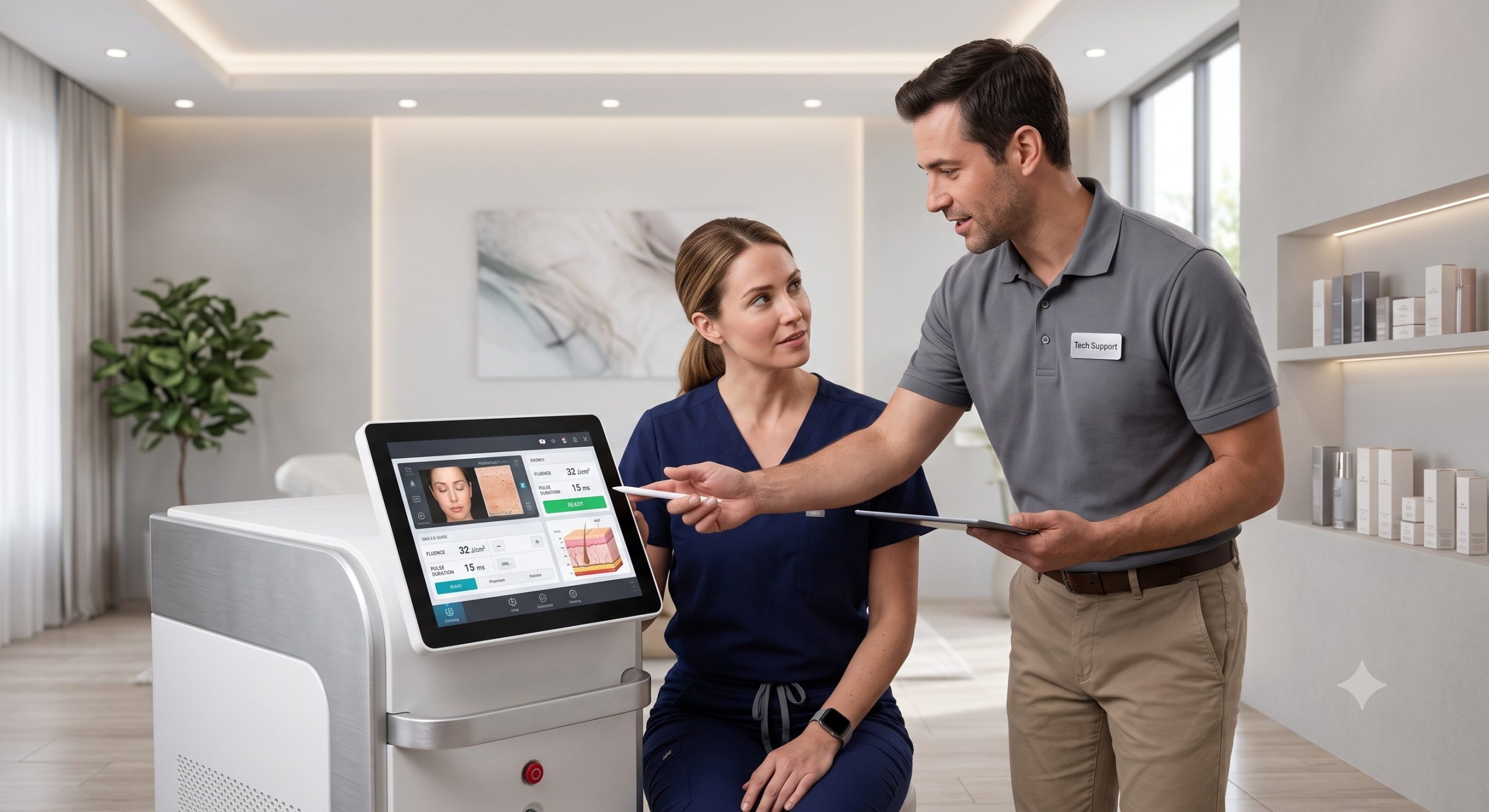
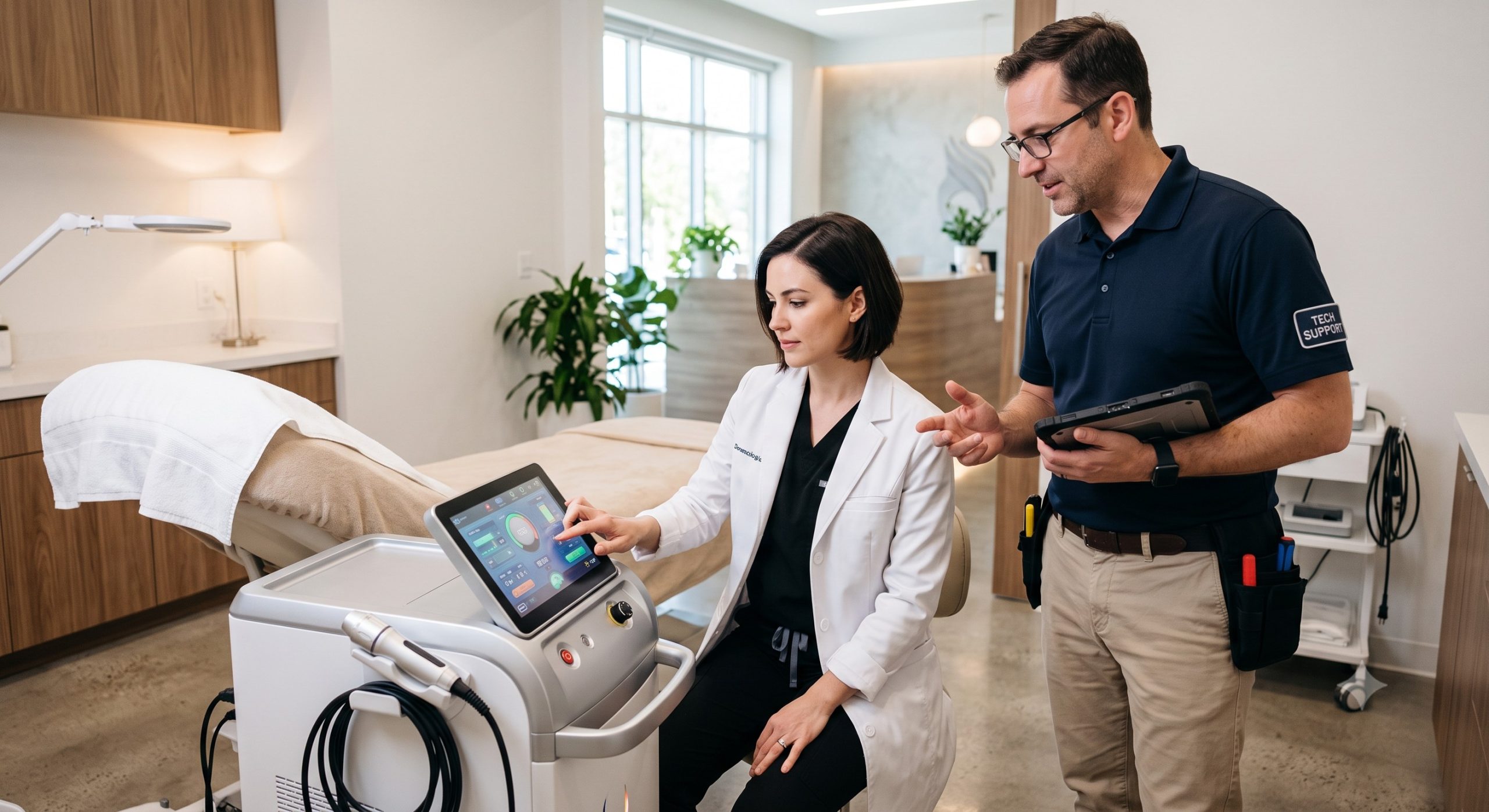
Standard B2B procurement includes (a) two-day on-site clinical training for up to 4 operators covering parameter selection for 14 indications, (b) remote technical support via encrypted live-view of the laser interface (with user permission), and (c) a 24-hour parts replacement SLA for the fiber drive module and power supply. Verify that the supplier provides a ‘loaner handpiece’ clause during any repair exceeding 3 business days—critical for clinics with high daily patient volume.
Q8: Can the Thulium Fiber Laser be integrated into my existing EMR and patient scheduling workflow?
Yes, the TFL control system includes a HL7-compatible API module that exports treatment parameters (total energy delivered, shots per session, fiber serial number) directly to major EMR platforms (Epic, Cerner, ModMed). For scheduling, the laser’s internal log generates a patient-specific ‘treatment passport’ PDF that auto-populates procedure codes (e.g., CPT 17999 for resurfacing). Integration is achieved via a standard Ethernet port using REST API calls—no proprietary gateways required.