
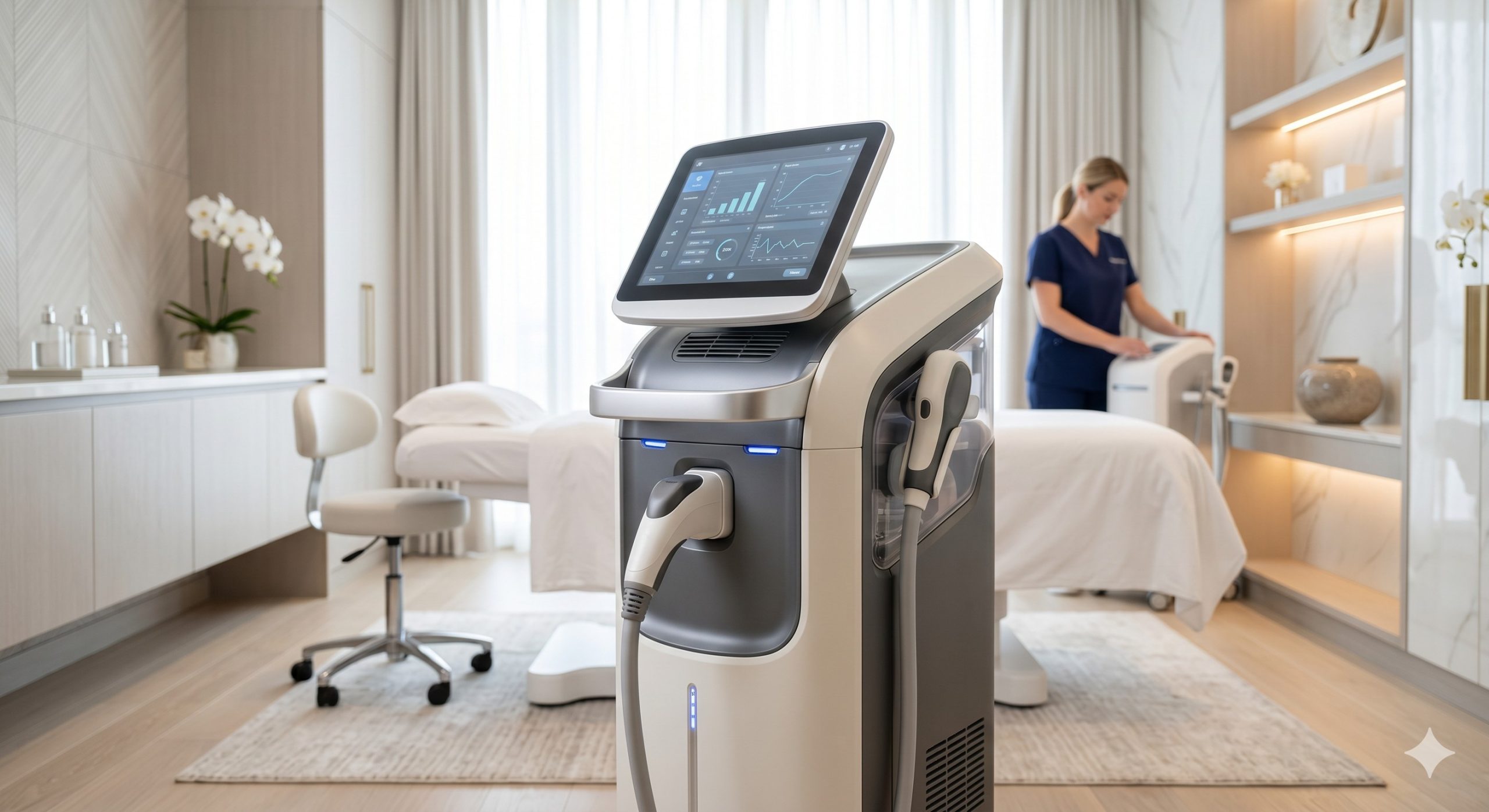
CLINICAL ARCHITECTURE & PERFORMANCE REFERENCE MANUAL: PICOSECOND LASER MACHINE
1. EXECUTIVE SUMMARY
This document provides a comprehensive technical and clinical overview of the next-generation Picosecond Laser Machine, a premium aesthetic platform engineered for the rapid photomechanical clearance of dermal and epidermal chromophores. By operating in the picosecond (10⁻¹² seconds) domain, this system shifts the therapeutic paradigm from selective photothermolysis to laser-induced optical breakdown (LIOB) and the generation of laser-induced cavitation bubbles. This mechanism significantly reduces thermal diffusion to surrounding tissues, thereby minimizing dyspigmentation risks and downtime while maximizing efficacy for tattoo removal, pigmented lesions, and skin rejuvenation.
2. CLINICAL ARCHITECTURE & DESIGN
The device utilizes a solid-state Nd:YAG laser source with proprietary optical pulse compression technology. The resonant cavity is thermally stabilized via a closed-loop chiller unit, ensuring ±1% pulse-to-pulse energy stability. Emission is delivered through a 7-articulated-arm counterbalanced handpiece assembly. The system integrates a high-transmission, anti-reflection coated optical pathway to preserve peak fluence (up to 1.8 GW/cm²). A user-configurable zoom handpiece provides adjustable spot sizes from 2 mm to 6 mm diameter without tool changes. The chassis is constructed from medical-grade antimicrobial ABS polymer, featuring passive venting channels that exceed IP21 ingress protection ratings.
3. KEY INDICATIONS & CAPABILITIES
– TATTOO REMOVAL (PROFESSIONAL & AMATEUR): Clears multi-colored inks using 1064 nm (dark pigments) and 532 nm (red/orange/yellow) via photomechanical shattering without bulk heating.
– PIGMENTED LESIONS: Treats solar lentigines, ephelides, and nevus of Ota. The short pulse width (≤450 ps) confines stress within melanosomes, reducing post-inflammatory hyperpigmentation risk.
– ACNE SCARS & TEXTURE: Diffractive lens array (DLA) handpiece option creates LIOB dermal micro-cavities, triggering neocollagenesis and elastin synthesis for atrophic scar remodeling.
– PHOTOAGING: Reduces rhytides and pores through subcellular vacuolization of dysplastic keratinocytes.
4. COMPLIANCE & STANDARDS
The Picosecond Laser Machine is manufactured in an ISO 13485:2016 certified facility. It holds FDA 510(k) clearance for tattoo removal and benign pigmented lesion treatment, alongside CE Mark (MDR 2017/745) certification for Class IIb medical devices. The system complies with IEC 60825-1:2014 (Laser Safety) and IEC 60601-2-22:2012 (Surgical Laser Equipment). Calibration is NIST-traceable. Class 4 laser product safety interlocks are integrated into every handpiece.
| Parameter | Specification |
|---|---|
| Laser Type / Wavelengths | Solid-State Nd:YAG / 1064 nm + 532 nm (optional 785 nm & 650 nm upgrade modules) |
| Pulse Duration | ≤ 450 picoseconds (450 x 10⁻¹² s) FWHM |
| Peak Power | Up to 1.8 GW/cm² (at 2 mm spot, 1.2 J/cm²) |
| Spot Size Range | 2 mm – 6 mm continuously variable (zoom handpiece) |
| Repetition Rate | Single shot – 10 Hz |
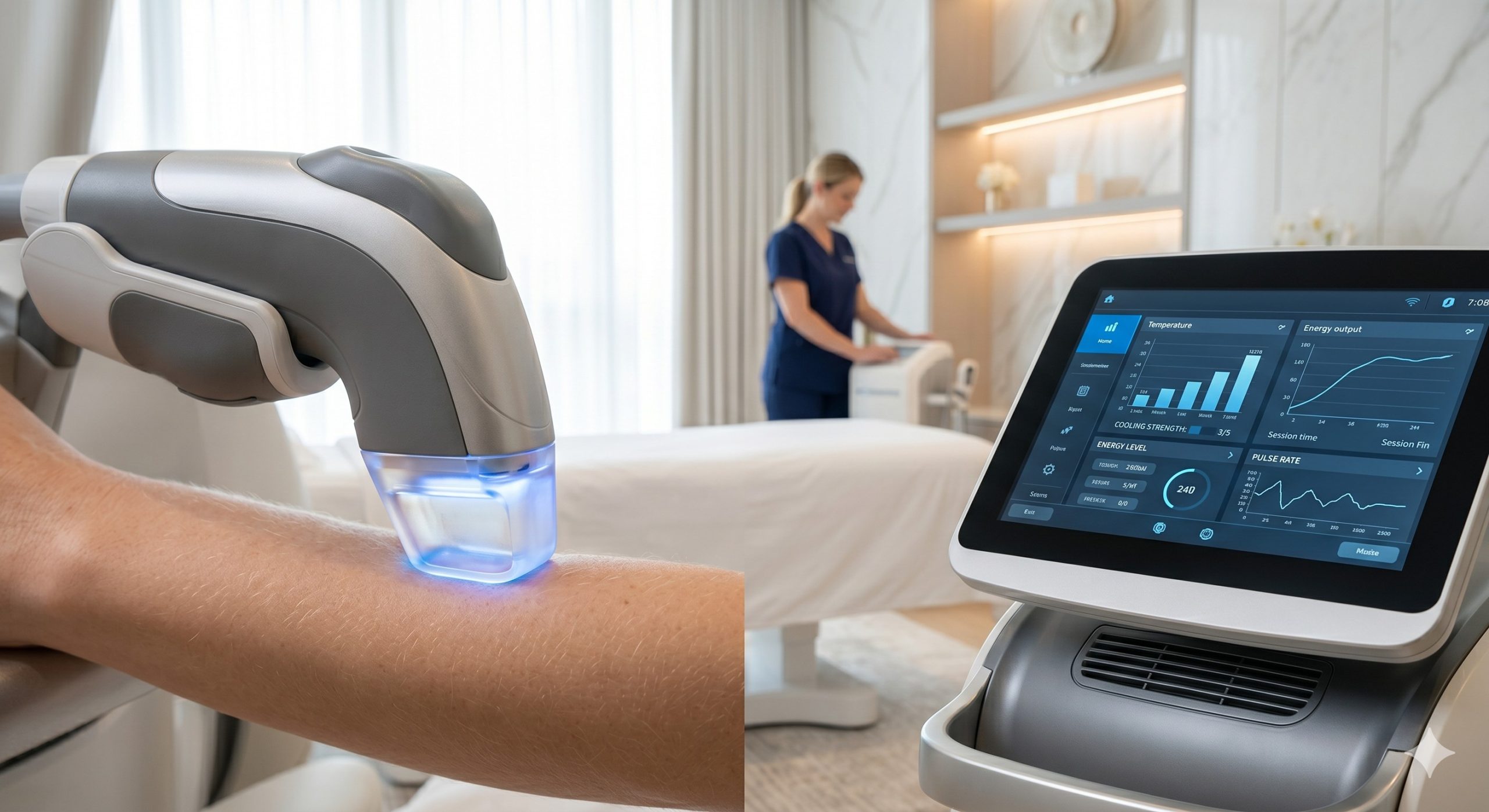
| Cooling System | Integrated R-404A-based cryogen spray (DCD) + air-cooled laser head |
| Display & Interface | 10.4″ high-brightness medical touchscreen; 50 treatment presets |
| Electrical | 100 – 240 VAC, 50/60 Hz, 15 A (auto-ranging) |
| Dimensions (WxDxH) | 42 cm x 52 cm x 108 cm (chassis only) |
| Weight | 38 kg (83.8 lbs) including articulated arm |
| Handpiece Cable Length | 1.8 m articulated, friction-locked |
| Environmental Operating Range | 15°C – 30°C, 20% – 80% RH non-condensing |
5. CLINICAL PROTOCOLS (ABSTRACT)
All treatments require appropriate eye shielding (patient, operator, and assistant). For tattoo removal: Fluence 0.5 – 2.5 J/cm², repetition rate 2 – 5 Hz, spot size 2 – 4 mm. Endpoint is immediate whitening (frosting) without epidermal disruption. For pigmented lesions: 532 nm, fluence 0.4 – 0.8 J/cm², 3 – 4 mm spot, single pass. Treatment intervals: 6 – 8 weeks for tattoos, 4 – 6 weeks for lesions. The onboard clinician advisor provides real-time fluence adjustments based on Fitzpatrick Skin Type (I – VI).
6. TISSUE SAFETY AND DOWNTIME PROFILE
Post-treatment erythema and edema typically resolve within 24 – 72 hours. Transient hyperpigmentation is observed in <5% of cases (Fitzpatrick IV-VI) and resolves spontaneously within 2 – 4 months. No routine analgesic is required due to the integrated dynamic cooling device (DCD) providing cryogen spray 30 ms prior to each pulse. Contraindications include active infection, melanoma history, isotretinoin use (last 6 months), and pregnancy.
Download Technical Specification
Click the button below to view or download the full official PDF datasheet.
Download Official PDF