
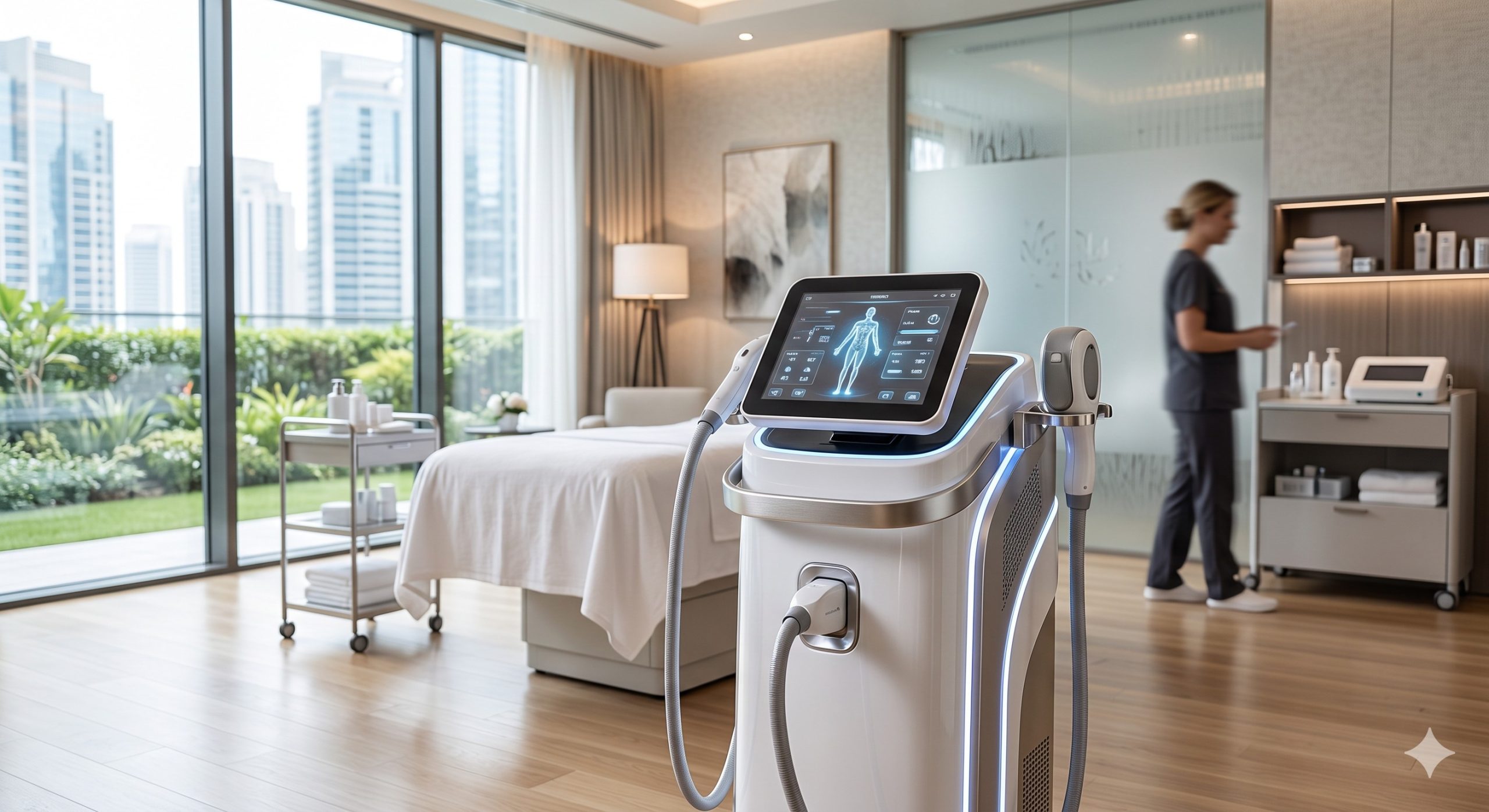
CLINICAL ARCHITECTURE & PERFORMANCE REFERENCE MANUAL: DUAL THULIUM LASER
EXECUTIVE SUMMARY
The dual-wavelength non-ablative fractional laser system, integrating a 1550 nm erbium glass fiber and a 1927 nm thulium fiber laser, represents a significant advancement in aesthetic dermatology. This system is engineered to address a broad spectrum of cutaneous concerns, from photoaging and dyschromia to scarring, while maintaining a superior safety profile across all Fitzpatrick skin types (FSTs).
This document provides a comprehensive technical and clinical overview of the platform, detailing its mechanism of action, core specifications, clinical indications, and safety protocols. The device is predicated on the principle of fractional photothermolysis, which creates microscopic treatment zones (MTZs) of thermal injury to stimulate dermal remodeling and epidermal renewal while preserving surrounding tissue for rapid healing .
CLINICAL ARCHITECTURE & DESIGN
OPTICAL SOURCE AND EMISSION PROFILES
The system features a dual-laser engine designed for synergistic tissue interaction. Each wavelength targets distinct chromophores and depths, enabling customizable treatment protocols.
1550 nm Erbium Glass Fiber Laser: This wavelength is highly effective for dermal rejuvenation. It targets water in the dermis, promoting neocollagenesis and elastin production. It is the primary wavelength for treating fine lines, periorbital wrinkles, and various types of atrophic scars .
1927 nm Thulium Fiber Laser: This wavelength demonstrates a higher affinity for water in the epidermis, making it the modality of choice for addressing epidermal pigmentation issues. It is specifically indicated for the treatment of actinic keratosis, solar lentigines, and general dyschromia .
FRACTIONAL PHOTOTHERMOLYSIS MECHANISM
The device operates via a scanning handpiece that delivers focused laser energy in an array of precise, microscopic columns. Each MTZ is approximately 100-500 µm in diameter and extends to a controlled depth within the tissue. The non-ablative nature of the system preserves the stratum corneum, creating a natural wound-healing response that is rapid and involves minimal downtime. Histologically, this results in the extrusion of epidermal necrotic debris, followed by significant dermal remodeling and collagen deposition over a 3-month period .
KEY INDICATIONS & CAPABILITIES
The dual-wavelength system is a versatile platform for a comprehensive range of dermatologic and aesthetic applications .
1550 nm WAVELENGTH INDICATIONS
– Skin Resurfacing: General photorejuvenation and improvement of skin texture.
– Facial Lines: Treatment of fine lines and periorbital wrinkles.
– Scarring: Management of acne scars and surgical scars.
– Cutaneous Lesions: Treatment of dyschromia, lentigines, and melasma.
1927 nm WAVELENGTH INDICATIONS
– Pigmentary Conditions: Targeting of age spots, sunspots, and ephelides.
– Precancerous Lesions: Treatment of actinic keratosis.
– Photoaging: Improvement of overall dyschromia and skin tone.
CAPABILITIES FOR SKIN OF COLOR
A significant attribute of this device is its safety and efficacy in patients with skin of color (FSTs III-VI). The near-infrared and infrared wavelengths (1550 nm and 1927 nm) minimize competitive absorption by melanin compared to shorter wavelengths, significantly reducing the risk of post-inflammatory hyperpigmentation (PIH) .
CLINICAL PROTOCOLS & DERMATOLOGIST REVIEW
BEST PRACTICES AND TREATMENT SETTINGS
A consensus of eight board-certified dermatologists with over ten years of experience established standardized treatment protocols to achieve optimal outcomes and minimize recovery time . These experts emphasized the importance of personalizing treatment parameters based on the specific condition, treatment area, and patient skin type.
CUSTOMIZABLE SETTINGS
– Energy (mJ): Adjusted based on desired depth of penetration and tissue response.
– Density (MTZ/cm2): Dictates the percentage of skin coverage treated per pass, influencing the intensity of the session.
– Total Energy (kJ): Monitored to manage the overall thermal load on the tissue.
For patients with darker skin types (FST IV-VI), dermatologists recommend a conservative starting approach, often reducing pulse energy and density to lower the incidence of adverse events like PIH . The integrated epidermal cooling system is crucial in these protocols to reduce epidermal heat buildup and inflammation.
COMPLIANCE & STANDARDS
The device adheres to stringent international medical device standards for safety and performance. All manufacturing and testing protocols are aligned with ISO 13485 quality management system requirements. The system is designed to comply with global regulatory frameworks, holding necessary clearances from bodies such as the US FDA and bearing the CE mark for distribution in the European Economic Area, confirming its conformity to health, safety, and environmental protection standards.
TECHNICAL SPECIFICATIONS
| Parameter | Specification |
|---|---|
| Primary Wavelengths | 1550 nm Erbium Glass & 1927 nm Thulium Fiber Lasers |
| Laser Classification | Non-Ablative Fractional |
| Indications (Primary) | Dyschromia, Fine Lines, Scars, Actinic Keratosis, Pigmented Lesions |
| Target Chromophores | Water (Dermis & Epidermis) |
| Skin Types | All Fitzpatrick Skin Types (I-VI) |
| Cooling Mechanism | Integrated Sapphire Tip & TEC / Water / Air Cooling |
| Approvals | FDA Cleared, CE Marked |
The system is engineered with a high-performance, air-cooled, water-cooled, or TEC (Thermoelectric Cooling) laser engine designed for clinical longevity and consistent output. The control interface utilizes advanced microprocessors to ensure pulse-to-pulse energy stability. The handpiece is engineered for ergonomic precision, integrating the optical delivery and sapphire cooling tip in a singular, balanced unit.
CLINICAL TISSUE SAFETY PROTOCOLS
The integrated, dynamic cooling system is a critical safety component, designed to protect the epidermis during energy delivery. By pre-cooling and continuously cooling the surface, the device minimizes pain and reduces the risk of thermal injury to the superficial layers . This allows for the use of clinically effective fluences while maintaining a comfortable patient experience.
Download Technical Specification
Click the button below to view or download the full official PDF datasheet.
Download Official PDF