EXECUTIVE SUMMARY
The Diode Laser Macro-Channel platform represents a paradigm shift in high-throughput medical aesthetic treatments, engineered specifically for clinical environments demanding uncompromised reliability, reproducibility, and patient throughput. This document serves as the definitive technical and clinical reference for the macro-channel diode laser architecture, detailing its advanced optical engineering, integrated epidermal protection systems, and the rigorous validation protocols that underpin its industry-leading performance consistency. Designed to deliver exceptional clearance rates for a broad spectrum of indications, the system’s robust construction and intelligent safety interlocks ensure sustained, high-fidelity operation even under the most demanding daily clinical schedules.
CLINICAL ARCHITECTURE & DESIGN
The foundational reliability of the Diode Laser Macro-Channel system is derived from its proprietary, high-density laser bar array, configured in a macro-channel geometry. This innovative design optimizes the spatial distribution of optical power, ensuring a homogeneous and highly efficient energy delivery profile across the entire treatment spot. The architecture minimizes thermal crosstalk between emitters, a common source of power degradation in conventional diode systems, thereby guaranteeing stable and predictable fluence output throughout the device’s operational life. This is complemented by a hermetically sealed optical cavity and a sophisticated thermal management system that actively dissipates waste heat, maintaining the laser diodes at their optimal operating temperature for maximum efficiency and longevity. The system’s architecture is a testament to precision engineering, focused on delivering reliable, repeatable clinical outcomes with every pulse.
KEY INDICATIONS & CAPABILITIES
Leveraging the principles of selective photothermolysis, the macro-channel diode laser platform is indicated for a comprehensive range of dermatological and aesthetic applications. The system’s primary capabilities include permanent hair reduction for all skin types (Fitzpatrick I-VI), utilizing optimal wavelengths (e.g., 808nm or a multi-wavelength configuration) to target melanin in the hair follicle while sparing the surrounding dermis. Its high peak power and large spot size enable rapid treatment of large body areas, significantly reducing session times and enhancing patient and clinician comfort. Furthermore, the system demonstrates efficacy in the treatment of vascular and pigmented lesions, offering a versatile solution for clinics seeking to expand their service portfolio. The precise control over pulse duration and fluence allows for customized treatment protocols tailored to individual patient anatomy and skin phototype, ensuring maximal efficacy and safety.
COMPLIANCE & STANDARDS
The Diode Laser Macro-Channel system is engineered and manufactured to meet the highest global standards for medical device safety and performance. The platform holds CE marking, confirming its conformity with the essential requirements of the Medical Device Regulation (MDR) 2017/745. It is also FDA 510(k) cleared for specific indications, demonstrating its safety and efficacy for commercial distribution in the United States. The device complies with the rigorous requirements of IEC 60601-1 (Medical Electrical Equipment – General requirements for basic safety and essential performance) and its relevant collateral standards for laser equipment (IEC 60601-2-22). These certifications are not merely regulatory hurdles but are integral to the device’s design philosophy, ensuring that every component and software function is validated against the strictest benchmarks for patient and operator safety. The manufacturing facility itself is certified under ISO 13485, a hallmark of quality management systems specific to the medical device industry.
TECHNICAL SPECIFICATIONS
The following section details the core technical parameters that define the Diode Laser Macro-Channel system’s performance capabilities and operational guidelines. These specifications are critical for clinicians and biomedical engineers to ensure proper integration into clinical workflows and the optimization of treatment protocols.
| Parameter | Specification |
|---|---|
| Laser Type / Wavelength | High-Power Diode Laser / 808nm (Standard), 755/808/1064nm (Multi-Wavelength Option) |
| Laser Classification | Class IV (FDA / IEC) |
| Peak Power Output | Up to 3000W (Dependent on Configuration) |
| Spot Size | 15 x 15 mm (Standard Macro-Channel), 10 x 10 mm (Optional) |
| Cooling System | Integrated Contact Cooling: Sapphire or TEC Cooling Tip, Air-Cooled Internal Chiller |
| Pulse Duration | 5 – 400 ms (Selectable) |
| Fluence (Energy Density) | 5 – 120 J/cm² (Dependent on Spot Size and Peak Power) |
| Repetition Rate | 1 – 10 Hz |
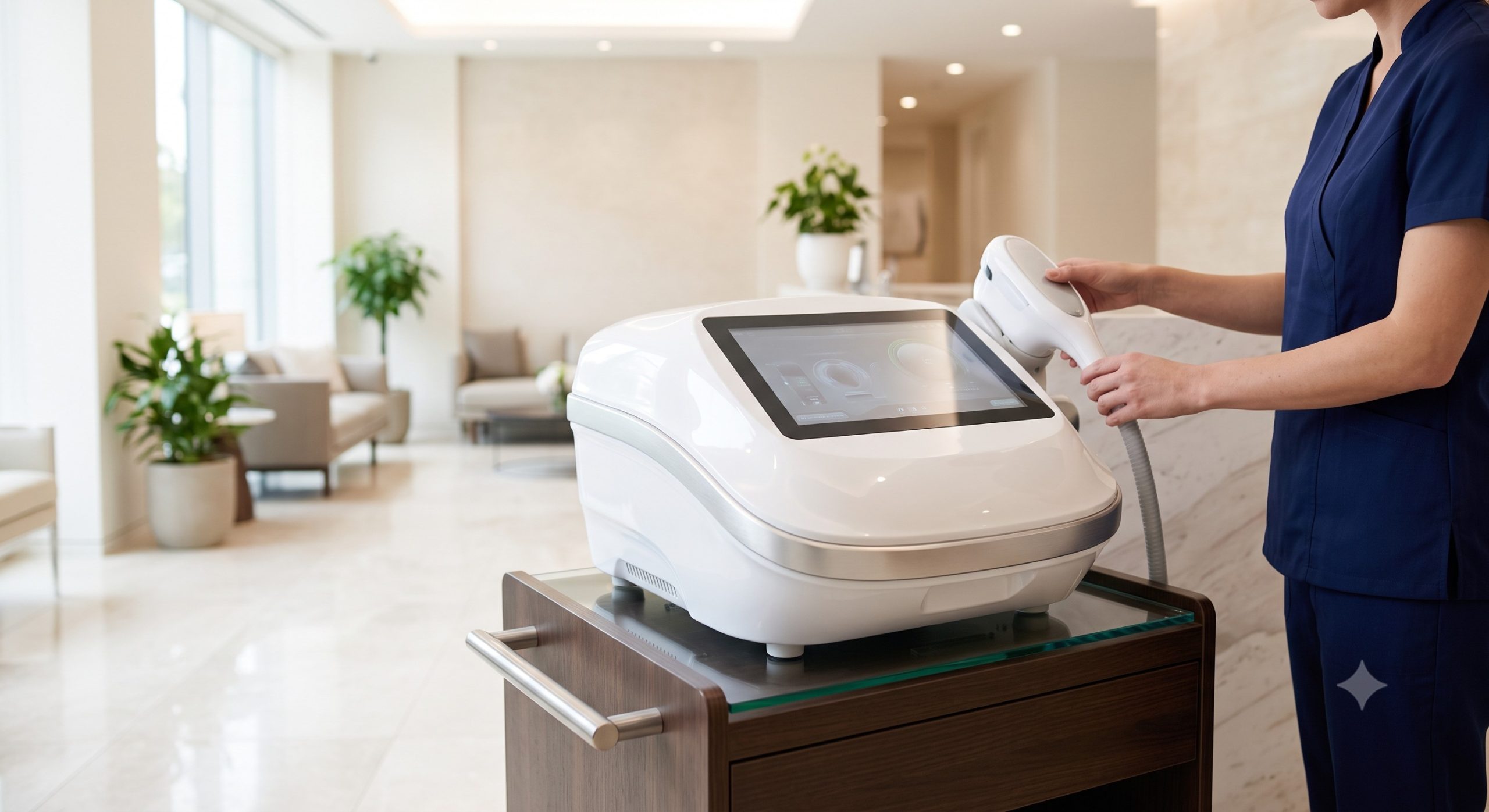
| User Interface | High-Resolution 12.1-inch Color Touchscreen, Intuitive GUI with Preset Protocols |
| Power Supply | 100-240VAC, 50/60Hz, 2000VA Max |
| Dimensions (Main Unit) | Approx. 45 x 55 x 110 cm (W x D x H) |
| Weight (Main Unit) | Approx. 80 kg |
| Operating Conditions | Ambient Temperature: 15°C – 30°C, Relative Humidity: 30% – 70% (Non-condensing) |
| Safety & Regulatory | CE (MDR), FDA 510(k) Cleared, IEC 60601-1, IEC 60601-2-22, ISO 13485 |
CLINICAL PROTOCOLS
Standardized clinical protocols are essential for maximizing treatment efficacy and ensuring patient safety. The Diode Laser Macro-Channel system features an intuitive touchscreen user interface that offers both pre-programmed, evidence-based treatment protocols and the flexibility for advanced users to manually adjust parameters. The pre-programmed protocols are categorized by skin type (Fitzpatrick scale) and treatment area, providing optimal starting parameters for fluence, pulse width, and repetition rate. A mandatory test pulse is incorporated into the system’s safety logic, allowing clinicians to assess the patient’s individual tissue response and make fine-tuning adjustments before the full treatment sequence. The system’s advanced contact cooling, often utilizing sapphire or thermoelectric (TEC) cooling, is automatically synchronized with the laser pulse to minimize epidermal heating and maximize patient comfort. Continuous temperature monitoring provides an additional layer of safety, automatically pausing energy delivery if the skin temperature deviates from the predetermined safe range. These integrated protocols are designed to deliver consistent, reproducible results while minimizing operator variability.
Download Technical Specification
Click the button below to view or download the full official PDF datasheet.
Download Official PDF