
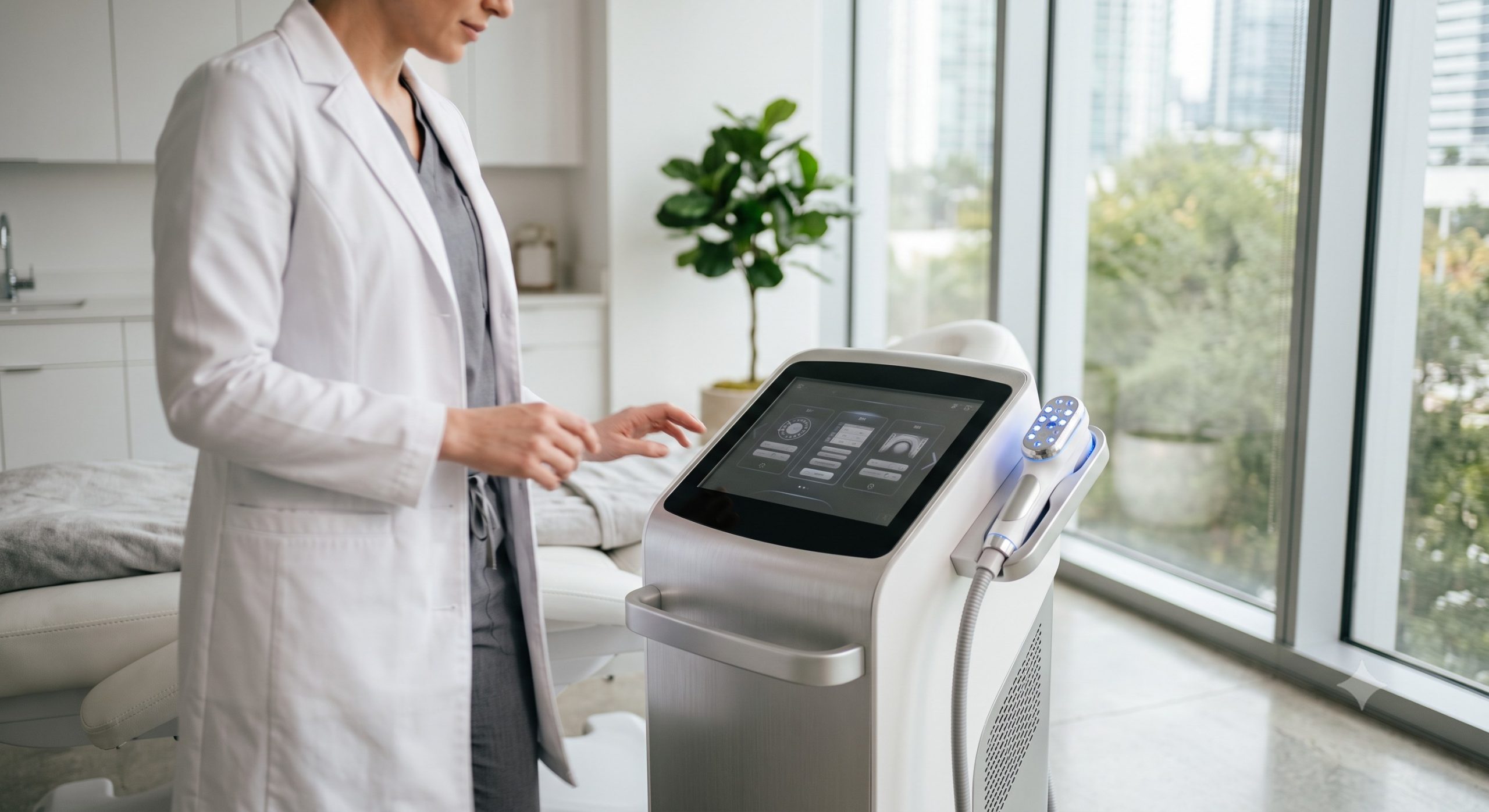
CLINICAL ARCHITECTURE & PERFORMANCE REFERENCE MANUAL: DUAL THULIUM LASER
EXECUTIVE SUMMARY
The Dual Thulium Laser platform represents a paradigm shift in dermatological and aesthetic medicine, combining two distinct thulium laser wavelengths within a single, integrated therapeutic system. This advanced device is engineered to deliver unparalleled precision for a broad spectrum of soft tissue procedures, including laser skin resurfacing, ablation, coagulation, and the treatment of benign pigmented lesions and vascular conditions. By leveraging the unique absorption properties of thulium-doped fiber laser technology, this system offers a superior alternative to traditional ablative and non-ablative lasers, providing clinicians with a versatile tool to achieve exceptional patient outcomes with minimized downtime. This document serves as the definitive technical reference, detailing the system’s clinical architecture, performance specifications, safety mechanisms, and operational protocols.
CLINICAL ARCHITECTURE & DESIGN
The cornerstone of the Dual Thulium Laser is its proprietary, dual-resonator optical engine. This sophisticated design incorporates two independent, high-power thulium fiber laser modules that can be operated sequentially or in a synchronized, stacked-pulse configuration. The system is engineered with a closed-loop feedback mechanism that continuously monitors and adjusts output energy, ensuring unparalleled pulse-to-pulse stability and consistency. The primary wavelength output is centered at 1927nm and 1940nm, which exhibit peak absorption coefficients for water and tissue water content, allowing for highly controlled, superficial to mid-depth tissue interaction. The optical delivery system utilizes a premium articulated arm with a precise, micromotor-driven galvanometer scanner for rapid, uniform pattern generation. The laser’s pulse duration is configurable from a short, ablative mode (e.g., 250 µs) to a longer, coagulative mode (e.g., 1.5 ms), granting the operator granular control over the thermal effect zone, from selective photothermolysis to volumetric tissue heating.
KEY INDICATIONS & CAPABILITIES
The device is cleared for a comprehensive range of indications. Its primary applications include:
– Fractional and Full-Field Laser Skin Resurfacing: For the treatment of photodamage, rhytides (fine lines and wrinkles), and textural irregularities (e.g., acne scars, surgical scars).
– Benign Pigmented Lesion Removal: Effective in treating solar lentigines, seborrheic keratosis, and other epidermal pigmented lesions through selective photothermolysis.
– Vascular Lesion Treatment: For the non-invasive treatment of telangiectasias, cherry angiomas, and other superficial vascular lesions.
– Onychomycosis Treatment: The 1940nm wavelength is particularly effective for laser treatment of fungal nail infections, penetrating the nail plate to target the underlying pathogen.
– Dermatological Surgery: Provides a precise, bloodless cutting and coagulation tool for the excision of benign skin lesions and other minor surgical procedures.
The system’s advanced scanning capabilities allow for customizable treatment patterns, including square, rectangular, circular, and linear shapes, with adjustable spot sizes and densities to accommodate varying skin types and anatomical locations.
COMPLIANCE & STANDARDS
The Dual Thulium Laser is manufactured in strict adherence to the highest international quality and safety standards. The device holds a CE Mark under the Medical Devices Directive (93/42/EEC) and is FDA 510(k) cleared for the specified indications. The manufacturing facility is certified under ISO 13485:2016, the international standard for quality management systems specific to medical devices. Additionally, the system complies with the essential requirements of IEC 60601-1 (Medical electrical equipment – Part 1: General requirements for basic safety and essential performance) and IEC 60825-1 (Safety of laser products – Part 1: Equipment classification, requirements, and user’s guide), placing it in Class 4 for laser products, necessitating robust safety features.
TECHNICAL SPECIFICATIONS
The following specifications define the core performance parameters of the system:
– Laser Type: Dual-Wavelength Thulium Fiber Laser (1927nm & 1940nm)
– Operating Modes: Pulsed, Fractional, Continuous Wave (for specific handpieces)
– Max Output Power: 60W (combined, depending on handpiece)
– Pulse Energy: Up to 100 mJ (per micro-pulse)
– Pulse Duration: 250 µs to 1.5 ms (software-selectable)
– Repetition Rate: 1 Hz to 250 Hz (depending on mode)
– Scanning Area (Max): 20 mm x 20 mm
– Spot Size (Min): < 100 µm (for fractional mode)
- Aiming Beam: 635nm, < 5mW, Class 2M Red Diode Laser
| Parameter | Specification |
|---|---|
| Laser Type / Wavelength | Dual-Wavelength Thulium Fiber Laser (1927nm & 1940nm) |
| Max Output Power | 60W (Combined, depending on handpiece) |
| Pulse Duration | 250 µs to 1.5 ms (Software-selectable) |
| Cooling System | TEC + Sapphire + Water + Wind (Active Skin Cooling) |
| Spot Size (Min) | < 100 µm (Fractional mode) |
| Aiming Beam | 635nm, < 5mW, Class 2M Red Diode Laser |
| Repetition Rate | 1 Hz to 250 Hz (Mode-dependent) |
| Pulse Energy | Up to 100 mJ (Per micro-pulse) |
CLINICAL PROTOCOLS
Optimal clinical outcomes are achieved through the selection of appropriate treatment parameters based on the specific indication, skin type (Fitzpatrick scale I-VI), and desired depth of effect. A standard protocol for fractional skin resurfacing involves a pre-treatment cleansing, followed by the application of a topical anesthetic (e.g., 30-60 minutes prior). The system’s proprietary ‘Smart Pulse’ technology should be utilized to automatically adjust fluence based on the selected spot size and skin type to maintain a safe and effective energy density. During the procedure, the handpiece is held perpendicular to the treatment area, and the scanning pattern is overlaid in a non-overlapping manner to ensure uniform coverage. For vascular lesions, a lower fluence with a longer pulse duration is recommended to facilitate selective heating and coagulation of the target vessel. Post-treatment, a soothing ointment or dressing is applied to the treated area. The system’s integrated Active Skin Cooling (TEC + Sapphire + Water + Wind) mechanism works in conjunction with these protocols to minimize epidermal heating and patient discomfort. It is imperative that all procedures are performed by a licensed, trained medical professional who is well-versed in laser safety protocols and the specific operation of this device.
Download Technical Specification
Click the button below to view or download the full official PDF datasheet.
Download Official PDF