EXECUTIVE SUMMARY
The Q-Switched Nd:YAG laser platform represents a paradigm shift in dermatological and aesthetic medicine, offering a versatile, high-performance solution for a wide spectrum of benign pigmented lesions, tattoo removal, and skin revitalization. This document provides a comprehensive technical and clinical overview of the system, detailing its advanced architectural design, treatment capabilities, and operational specifications. Engineered for precision and patient safety, this device integrates state-of-the-art Q-switching technology to deliver ultra-short, high-peak-power pulses that adhere to the principle of selective photothermolysis, ensuring maximal efficacy with minimal collateral thermal damage to surrounding tissues.
CLINICAL ARCHITECTURE & DESIGN
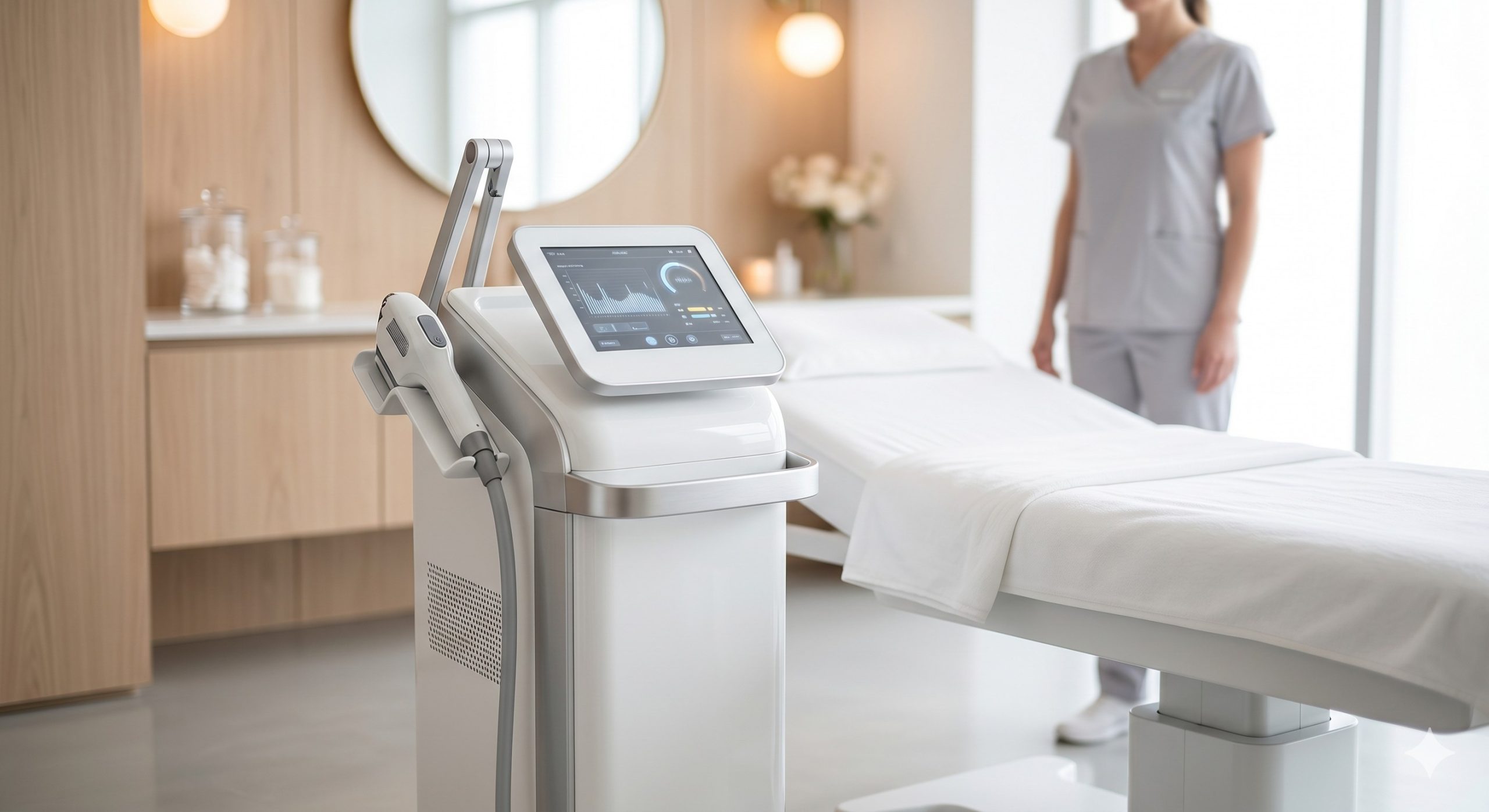
The core of the system is a solid-state Nd:YAG laser rod, optically pumped by high-energy flashlamps. The Q-switching mechanism, typically an acousto-optic or electro-optic modulator, is employed to produce pulses in the nanosecond regime. This results in peak powers that can reach into the megawatt range, which are essential for the photoacoustic disruption of targeted chromophores. The system features a sophisticated, articulating arm or fiber-optic delivery system to guide the laser energy to the treatment handpiece. The device’s chassis is constructed from high-grade medical polymers and metals, designed for durability and seamless integration into any clinical environment. The internal architecture is further enhanced by a closed-loop deionized water cooling system that dissipates thermal energy from the laser cavity and the handpiece, ensuring stable and consistent output over extended treatment sessions.
KEY INDICATIONS & CAPABILITIES
This Q-Switched Nd:YAG laser is indicated for a diverse range of dermatological conditions and aesthetic treatments:
– TATTOO REMOVAL: Effective on professional, amateur, and traumatic tattoos. Its dual-wavelength capability allows for the treatment of a broad spectrum of ink colors. The 1064nm wavelength is ideal for dark inks (black, blue, green), while the 532nm wavelength (frequency-doubled) targets red, orange, and yellow pigments.
– PIGMENTED LESIONS: Clearance of solar lentigines, ephelides (freckles), café-au-lait macules, and nevus of Ota. The precise energy delivery ensures selective targeting of melanosomes.
– SKIN REJUVENATION & TEXTURE IMPROVEMENT: Low-fluence, high-repetition-rate treatments in a ‘soft’ or ‘toning’ mode can stimulate neocollagenesis and improve overall skin tone, texture, and clarity.
– BENIGN DERMAL NEVI: Effective in the treatment of specific dermal pigmented lesions.
COMPLIANCE & STANDARDS
The Q-Switched Nd:YAG laser system is manufactured in strict accordance with international medical device regulations and safety standards. It holds CE marking, confirming compliance with the European Medical Devices Regulation (MDR). The device is also engineered to meet the rigorous requirements of the U.S. Food and Drug Administration (FDA) for specific aesthetic and dermatological indications. Key compliance certifications include:
– IEC 60825-1: Safety of laser products.
– ISO 13485: Quality management systems for medical devices.
– FDA 21 CFR Part 1040.10 and 1040.11, with deviations pursuant to Laser Notice No. 50.
TECHNICAL SPECIFICATIONS
The system’s robust technical framework is defined by the following core specifications:
| Parameter | Specification |
|---|---|
| Laser Type | Q-Switched Nd:YAG |
| Wavelengths | 1064 nm (Fundamental) & 532 nm (Frequency-Doubled) |
| Pulse Duration | < 10 ns |
| Maximum Output Energy | 1200 mJ @ 1064 nm / 600 mJ @ 532 nm |
| Repetition Rate | 1 – 10 Hz |
| Spot Size Range | 1 – 8 mm (Continuously Adjustable or Interchangeable) |
| Cooling System | Integrated Deionized Water-to-Air (Closed Loop) |
| Delivery System | Articulating Arm with 7-Joint Movement |
CLINICAL PROTOCOLS
For optimal clinical outcomes, the following protocols are recommended as a foundational guide:
– TATTOO REMOVAL (1064nm): Start with a fluence of 4-6 J/cm² and a spot size of 2-3mm. Observe the immediate whitening (frosting) of the treated area as an endpoint. Adjust fluence based on the patient’s skin type and the density of the ink.
– TATTOO REMOVAL (532nm): Use a fluence of 1.5-2.5 J/cm² with a spot size of 2-3mm. The endpoint is a subtle grayish whitening or pinpoint bleeding for epidermal pigments.
– PIGMENTED LESIONS (1064nm): For deeper dermal lesions, a fluence of 5-8 J/cm² with a 3-4mm spot size is typical. For epidermal lesions, a lower fluence with a larger spot size may be used.
– SKIN TONING (1064nm): Employ a large spot size (6-8mm) and low fluence (0.8-1.5 J/cm²). Use a high repetition rate (5-10Hz) for a rapid, gentle treatment. The endpoint is mild erythema and a uniform warming of the skin.
All protocols must be preceded by a thorough patient consultation, skin type assessment (Fitzpatrick scale), and a test patch to determine the individual’s response. Post-treatment care instructions, including sun avoidance and the use of topical antibiotics, are critical to ensure optimal healing and to minimize the risk of side effects.
Download Technical Specification
Click the button below to view or download the full official PDF datasheet.
Download Official PDF