
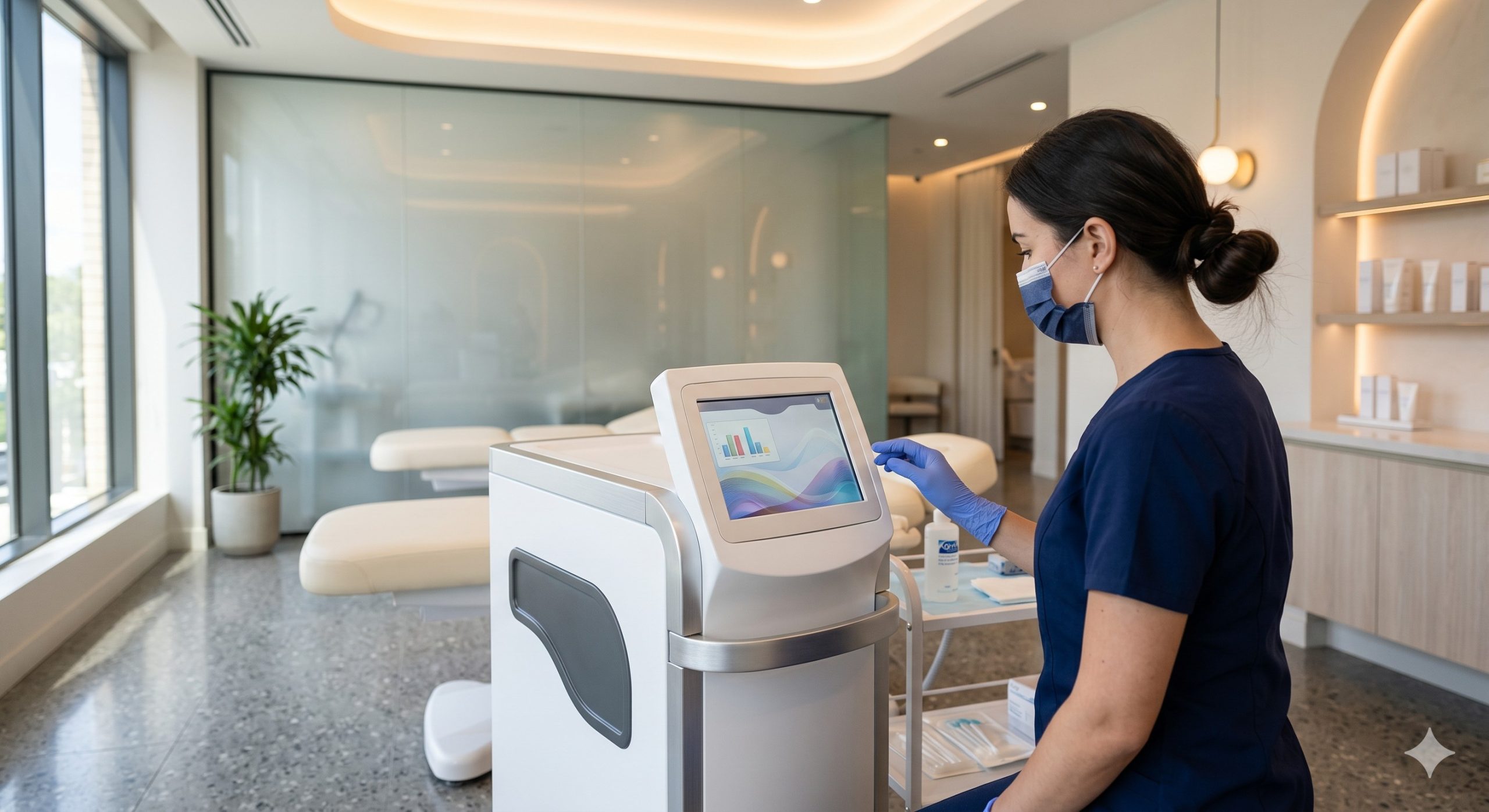
SELECTIVE PHOTOTHERMOLYSIS ARCHITECTURE REFERENCE DOCUMENT: DIODE LASER HAIR REMOVAL
MECHANISM PHILOSOPHY
This document delineates the engineering and clinical foundations of high-power diode laser hair removal systems manufactured under ISO 13485 quality management frameworks. Diode laser hair removal operates on the principle of selective photothermolysis, wherein 800-810 nm wavelengths (or multi-wavelength configurations including 755 nm, 810 nm, and 1064 nm) are preferentially absorbed by melanin within the hair follicle while sparing surrounding dermal tissues. The pulse duration is calibrated to approximate the thermal relaxation time of terminal hair follicles (10-50 milliseconds), inducing coagulative necrosis of the follicular bulge and germinal matrix. Clinical clearance rates range from 70% to 90% after a series of 4-6 treatments spaced at 4-8 week intervals, dependent upon anatomic site, hair cycle stage (anagen phase susceptibility), and Fitzpatrick skin type.
ENERGY TRANSMISSION DYNAMICS
The emission profile is generated by gallium arsenide (GaAs) diode laser bars mounted on thermoelectric coolers (TEC) with copper heat sinks. The optical delivery system comprises a articulated handpiece with multi-spot capability. Fluence is adjustable from 5 J/cm² to 120 J/cm², with pulse widths ranging 5 ms to 400 ms. Repetition rates up to 10 Hz enable rapid scanning of large areas (e.g., back, legs). Integrated contact cooling via sapphire window (0°C to 5°C surface temperature) reduces epidermal thermal injury, enabling safe treatment up to Fitzpatrick skin type VI with appropriate parameter selection. The spot size portfolio includes 12×12 mm, 15×15 mm, 9×9 mm, and 6×6 mm adapters, allowing transition between high-speed bulk treatment and precision applications (e.g., upper lip, eyebrows).
CLINICAL ADVANTAGES
Compared to alternative light-based technologies (IPL, alexandrite, Nd:YAG), diode lasers offer:
– Optimal melanin absorption coefficient at 800-810 nm, balanced between epidermal safety and follicular targeting.
– Extended pulse duration capability (>100 ms) for large-diameter terminal hairs and darker skin types.
– High average power (up to 2000 W) enabling short treatment sessions: full legs in 15-20 minutes, back in 12-15 minutes.
– Low maintenance: solid-state architecture with 10-15 million shot life expectancy before diode bar replacement.
– Real-time contact cooling reduces anesthetic requirement — topical anesthesia necessary only for highly sensitive regions (Brazilian, axillae).
CERTIFICATIONS MATRIX
Regulatory clearances include:
– FDA 510(k) clearance for permanent hair reduction (Class II medical device).
– CE Mark (MDR 2017/745) as an active therapeutic device with cooling function.
– IEC 60601-1 (electrical safety), IEC 60601-2-22 (laser surgical device safety), and IEC 60825-1 (laser product classification — Class 4).
– ISO 13485:2016 certified production facility.
– China NMPA registration for select configurations.
– ISO 9001:2015 quality management.
EXACT SPECIFICATIONS
HARDWARE PLATFORM:
– Laser source: Diode laser stack (GaAs), 600W – 2000W peak power depending on configuration.
– Primary wavelength: 808 nm ± 10 nm.
– Optional tri-wavelength module: 755 nm / 808 nm / 1064 nm selectable via handpiece or software control.
– Fluence range: 5 – 120 J/cm² (step size 1 J/cm²).
– Pulse width: 5 – 400 ms (adjustable in 1 ms increments).
– Repetition rate: 1 – 10 Hz.
– Spot sizes: 6×6 mm, 9×9 mm, 12×12 mm, 15×15 mm square spots; optional 10×20 mm rectangular for large surfaces.
– Cooling system: Dual-stage TEC + sapphire contact plate (0-5°C adjustable) + closed-loop water circulation + forced air exhaust.
– Display: 10.1-inch capacitive touchscreen, 1280×800 IPS, anti-reflective.
– User interface language: English, Spanish, German, French, Italian, Portuguese, Arabic, Chinese, Russian.
– Treatment count memory: up to 100,000 stored treatment logs.
– Data export: USB-A port (CSV, PDF), optional Wi-Fi/Ethernet for EMR integration.
– Dimensions (main console): 45 cm (W) x 55 cm (D) x 110 cm (H) – 19.5 inches x 21.5 inches x 43 inches.
– Weight: 48 kg (106 lbs).
– Electrical: 110-240 VAC, 50/60 Hz, 15A maximum draw (2000W configuration requires 20A dedicated circuit).
– Warranty: 24 months full system, 12 months or 10 million shots on diode bar.
| Parameter | Specification |
|---|---|
| Laser Type / Wavelength | 808 nm Diode (standard) / Optional 755/808/1064 nm tri-wavelength |
| Spot Size (standard) | 15×15 mm (primary), 12×12 mm, 9×9 mm, 6×6 mm |
| Cooling System | TEC + Sapphire contact cooling (0-5°C) + closed-loop water + forced air |
| Fluence (Energy Density) | 5 – 120 J/cm² (1 J/cm² increments) |
| Pulse Width | 5 – 400 ms (1 ms increments) |
| Repetition Rate | 1 – 10 Hz |
| Peak Power | 600W / 1200W / 2000W (configurable) |
| Display | 10.1-inch Capacitive Touchscreen (1280×800) |
| Electrical | 110-240 VAC, 50/60 Hz, 15A (2000W model requires 20A dedicated circuit) |
| Dimensions (WxDxH) | 45 cm x 55 cm x 110 cm (19.5″ x 21.5″ x 43″) |
| Weight | 48 kg (106 lbs) |
| Warranty | 24 months system / 12 months or 10M shots (diode bar) |
OPERATIONAL ROI SCHEMATIC
Clinic integration requirements: dedicated treatment room with ambient temperature 18-25°C, relative humidity 20-80% non-condensing. Floor space: minimum 3 m x 3 m (10 ft x 10 ft) including patient table and practitioner access. Laser safety signage at entrance, Class 4 laser controlled area protocols including window shielding and interlocks as per local regulations (ANSI Z136.3 for US clinics). Protective eyewear required for patient (wavelength-specific OD 5+ at 755-1064 nm) and practitioner (same). All staff shall complete laser safety officer (LSO) training and device-specific didactic and practical certification.
Clinical workflow:
1. Consultation: Fitzpatrick skin typing, hair color assessment, medical history (contraindications: isotretinoin use, active infection, photosensitivity disorders, pregnancy, tattoo within treatment field).
2. Test spot at low fluence (10-12 J/cm²) in inconspicuous area; observe for 10-15 minutes for adverse reaction.
3. Pre-treatment: Shave treatment area (do not wax or pluck), cleanse skin, apply topical anesthetic if indicated (lidocaine 2.5% / prilocaine 2.5% under occlusion for 30 min).
4. Parameter selection based on skin type and hair density: Fitzpatrick I-III: 20-40 J/cm², 10-30 ms pulse width; Fitzpatrick IV-VI: 12-25 J/cm², 30-100 ms pulse width. Dark coarse hair requires higher fluence, fine vellus hair requires lower fluence.
5. Treatment technique: Handpiece perpendicular to skin, full contact, slight stretch to flatten skin; overlapping spots ≤10% to avoid gaps; avoid double-pulsing in same location.
6. Post-treatment: Erythema and perifollicular edema (expected, resolves in 24-72 hours). Broad-spectrum SPF 30+ sunscreen for 2 weeks. Avoid heat exposure (sauna, hot showers, exercise) for 24-48 hours.
7. Follow-up schedule: 4-8 week intervals for body; 6-10 weeks for face.
Expected adverse events (incidence <5%): transient erythema, edema, blistering (rare, from excessive fluence), post-inflammatory hyperpigmentation (higher risk in Fitzpatrick IV-VI, usually resolves in 3-6 months), paradoxical hypertrichosis (rare, more common in face/neck of Mediterranean and Middle Eastern phenotypes). Storage and transport conditions: -10°C to +50°C, 10-90% RH non-condensing. System should be powered off and water circuit drained before extended storage (>30 days) or transport below freezing.
Download Technical Specification
Click the button below to view or download the full official PDF datasheet.
Download Official PDF