
SELECTIVE PHOTOTHERMOLYSIS ARCHITECTURE REFERENCE DOCUMENT: PROFESSIONAL LASER HAIR REMOVAL
EXECUTIVE SUMMARY
This document serves as the definitive clinical and technical reference for the deployment of professional laser hair removal systems within medical aesthetic practices. The architecture is predicated on the principle of selective photothermolysis, utilizing a specific wavelength, pulse duration, and fluence to achieve irreversible thermal damage to the dermal papilla and hair follicle stem cells without compromising the surrounding epidermis. This system represents a paradigm shift in permanent hair reduction, offering a superior safety profile, enhanced patient comfort, and unparalleled clinical efficacy across a broad spectrum of Fitzpatrick skin types. The following sections delineate the platform’s engineering, operational parameters, and integration protocols for high-performance clinical environments.
CLINICAL ARCHITECTURE & DESIGN
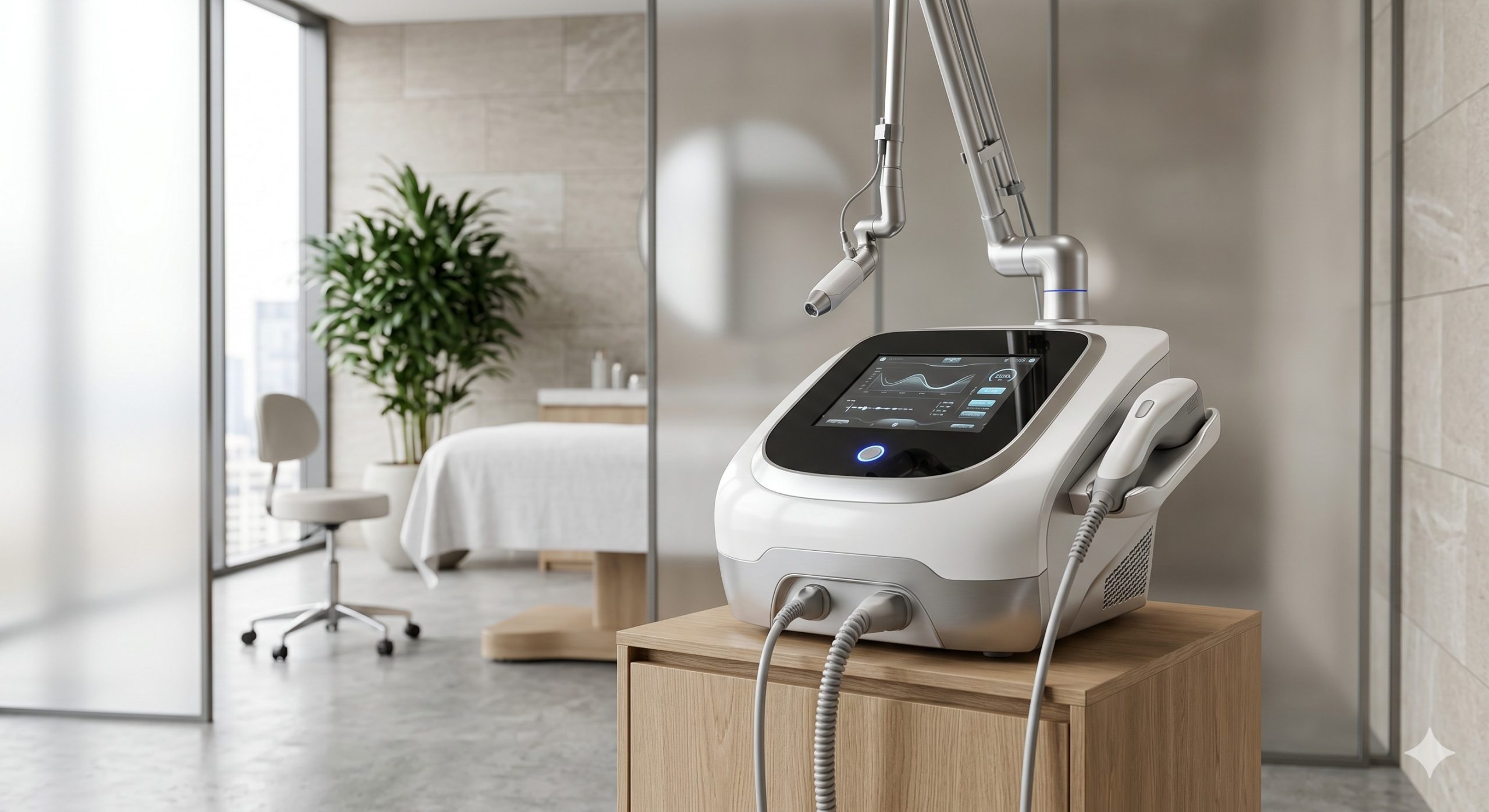
The platform’s foundational architecture is a culmination of advanced optical engineering and sophisticated thermal management. At its core lies a high-power, air-cooled laser diode array engineered for exceptional pulse-to-pulse stability and extended operational longevity. The system integrates a proprietary, multi-stage cooling engine that synergistically combines thermoelectric cooling (TEC) modules with a recirculating fluid circuit to actively maintain the laser diode’s optimal operating temperature, thereby ensuring consistent energy delivery throughout the treatment session. The beam delivery system utilizes a micro-lens array to homogenize the energy profile, producing a top-hat beam that eliminates hot spots and ensures uniform fluence across the entire spot. This design philosophy is critical for achieving predictable clinical outcomes and minimizing the risk of adverse events, establishing the device as a benchmark for safety and precision in aesthetic dermatology.
KEY INDICATIONS & CAPABILITIES
The system is clinically indicated for the permanent reduction of unwanted hair on all body areas, including the face, neck, axillae, legs, arms, and bikini line. Its versatile emission profile, encompassing 755 nm (Alexandrite), 808 nm (Diode), and 1064 nm (Nd:YAG), allows the clinician to precisely target the melanin within the hair shaft across a variety of skin tones. This multi-wavelength capability is not merely a feature but a strategic clinical tool, enabling the practitioner to tailor treatment parameters to the patient’s unique chromophore characteristics. The rapid repetition rate and large spot size facilitate high-speed treatment, significantly reducing procedural times for larger anatomical areas and optimizing clinic throughput. This capability, combined with a built-in skin contact cooling system, ensures that treatments are not only effective but also exceptionally comfortable, elevating the patient experience and encouraging adherence to the complete treatment regimen.
COMPLIANCE & STANDARDS
This laser hair removal platform is designed and manufactured in strict accordance with the highest international regulatory standards. It holds CE certification under the Medical Device Directive (MDD) 93/42/EEC and has received 510(k) clearance from the U.S. Food and Drug Administration (FDA) for permanent hair reduction. The device complies with the rigorous safety and performance requirements of IEC 60601-1 (Medical electrical equipment – Part 1: General requirements for basic safety and essential performance) and IEC 60601-2-22 (Particular requirements for basic safety and essential performance of surgical, cosmetic, therapeutic and diagnostic laser equipment). These accreditations ensure that the system meets all necessary criteria for electrical safety, laser emission safety, and electromagnetic compatibility (EMC), providing clinic operators and patients with an absolute guarantee of safety and reliability in a clinical setting.
TECHNICAL SPECIFICATIONS
The system is engineered as a standalone, mobile platform, featuring an intuitive, high-resolution capacitive touchscreen interface that serves as the central control hub for all treatment parameters. The device’s core specifications are meticulously calibrated to deliver superior clinical performance. The power source is designed for global compatibility, automatically adapting to varying mains voltages. The handpiece is ergonomically engineered to reduce operator fatigue during extended treatment sessions, and its quick-connect design facilitates seamless swapping. The system’s integrated consumable counter provides proactive maintenance alerts, ensuring the device is always operating at peak efficiency.
| Parameter | Specification |
|---|---|
| Laser Type / Wavelength | 755nm (Alexandrite) / 808nm (Diode) / 1064nm (Nd:YAG) |
| Fluence (Energy Density) | Adjustable: 5 – 50 J/cm² (Wavelength Dependent) |
| Pulse Duration | Adjustable: 5 – 500 ms |
| Repetition Rate | Up to 10 Hz |
| Spot Size | 15 mm x 15 mm (Standard) / 10 mm x 24 mm (Large Area – Optional) |
| Cooling System | Integrated Sapphire Contact Cooling + TEC + Water Circulation |
| Power Input | 100 – 240 VAC, 50/60 Hz, 1500 VA |
| Display | 10.1-inch Capacitive Touchscreen |
| Dimensions (W x D x H) | 430 mm x 480 mm x 1050 mm |
| Weight | Approx. 35 kg |
CLINICAL PROTOCOLS
Standard clinical protocols are established to ensure optimal and safe utilization of the device. Prior to each treatment, a comprehensive patient consultation is mandated to assess medical history, skin type, and hair color, culminating in a patch test to determine the minimal effective fluence. The treatment area must be cleansed, shaved, and a protective cooling gel may be applied, though the device’s integrated cooling system reduces this dependency. The clinician selects the appropriate wavelength, fluence, and pulse duration based on the patient’s Fitzpatrick skin type and hair characteristics. The handpiece is placed perpendicularly to the skin, ensuring full contact with the integrated skin sensor to prevent accidental firing. An overlap of 10-20% between pulses is recommended to ensure no hair follicles are missed. Post-treatment, patients are advised on strict sun avoidance protocols and the application of broad-spectrum sunscreen to mitigate the risk of hyperpigmentation. A series of 4-6 sessions, spaced 4-8 weeks apart, is typically required to achieve maximal permanent hair reduction, aligning with the natural hair growth cycle.
Download Technical Specification
Click the button below to view or download the full official PDF datasheet.
Download Official PDF