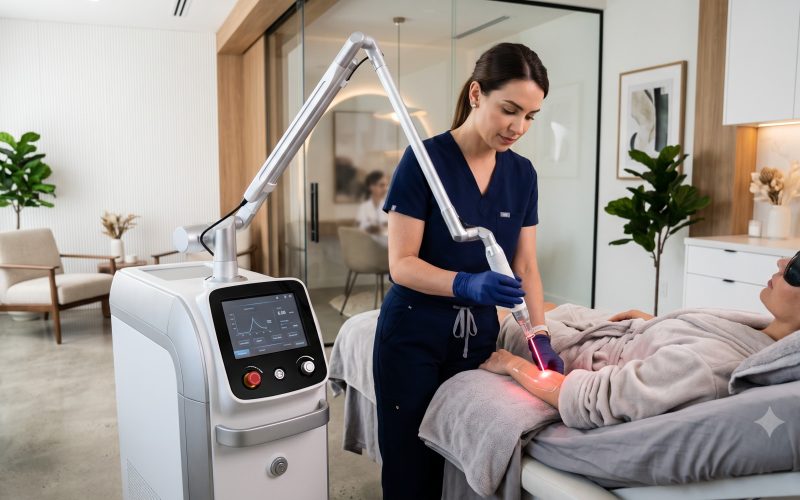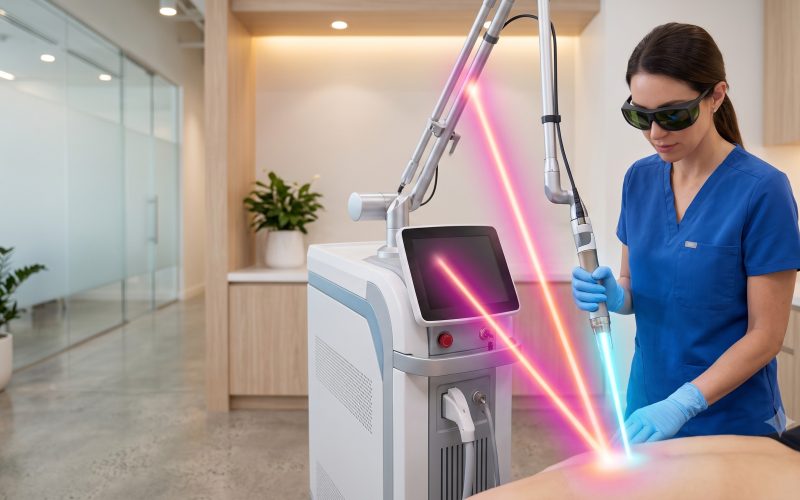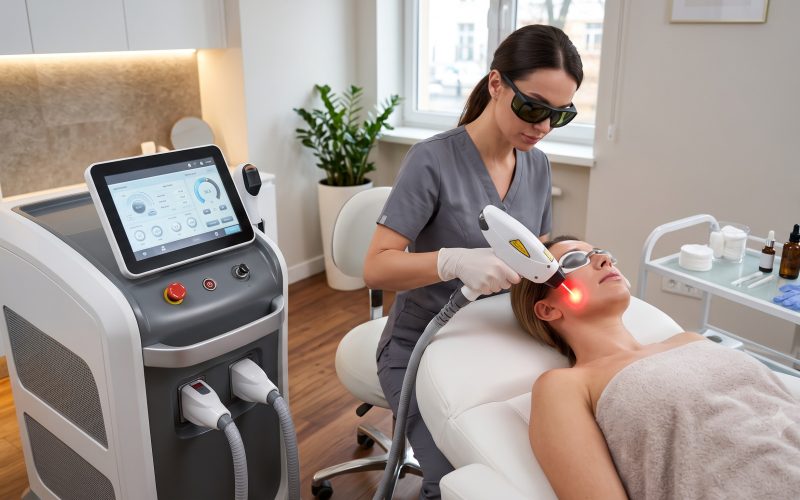
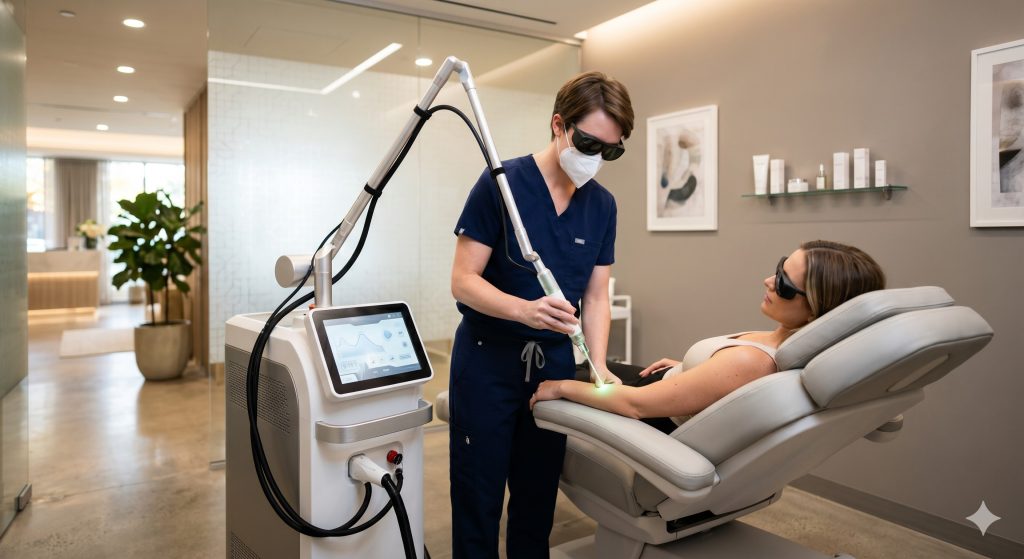
Introduction: The Clinic’s Dilemma With Tattoo and Pigment Removal
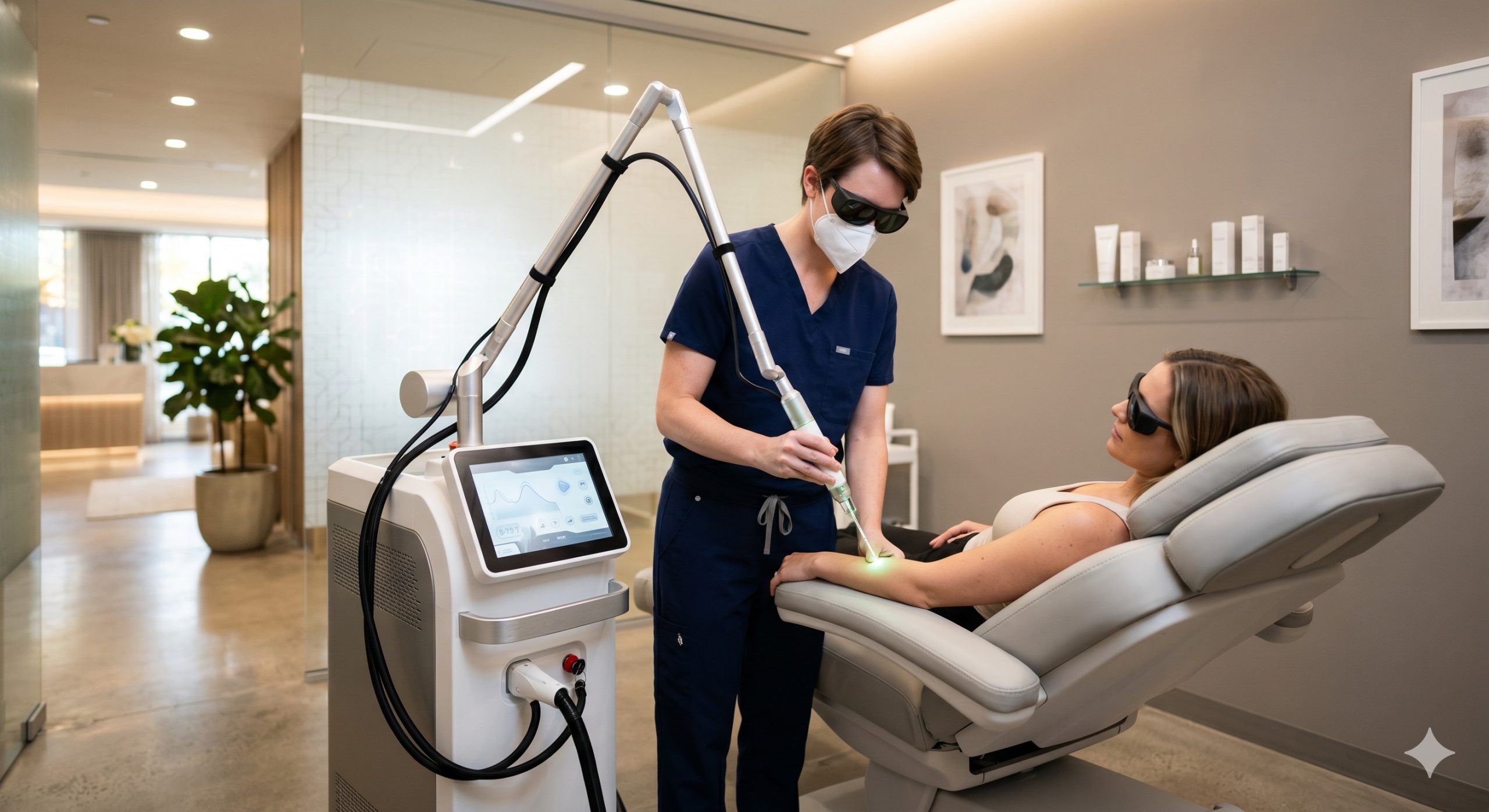
For years, aesthetic clinics have struggled with the limitations of Q-switched nanosecond lasers—stubborn multicolored tattoos, refractory melasma, and post-inflammatory hyperpigmentation (PIH) risks in higher Fitzpatrick skin types. The picosecond laser machine represents a paradigm shift in selective photothermolysis, delivering pulse widths in the trillionths of a second (10⁻¹² s) rather than billionths (10⁻⁹ s). This dramatic compression creates a primarily optoacoustic rather than photothermal effect, shattering targeted chromophores into dust particles small enough for macrophages to eliminate rapidly. For the clinical buyer, understanding the engineering beneath the handpiece is no longer optional—it dictates both patient safety and practice profitability.
Physical Mechanisms: Why Picosecond Pulse Width Outperforms Nanosecond
From Thermal Diffusion to Pressure Wave Dominance
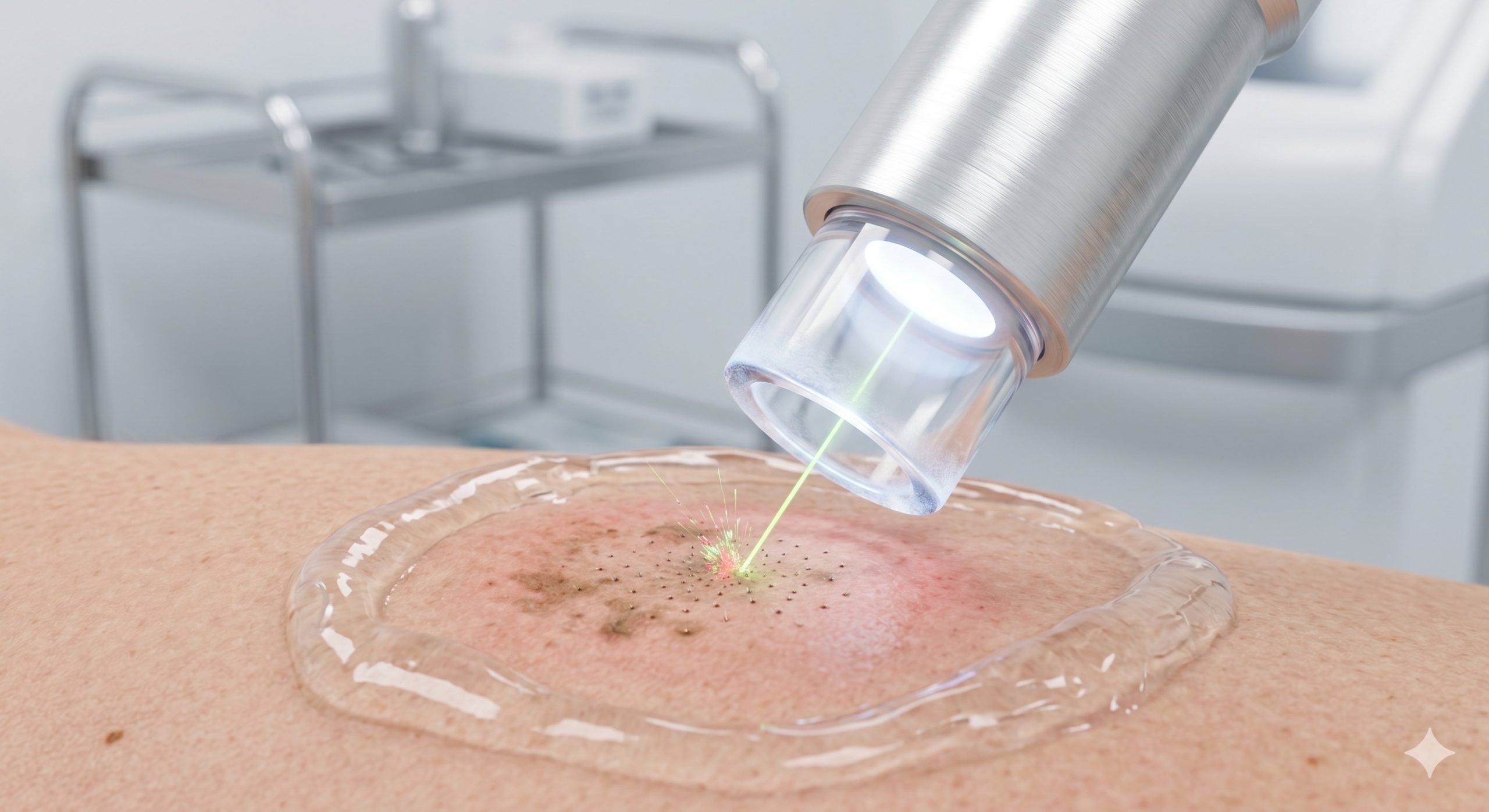
In a conventional Q-switched laser, the pulse duration (5–20 ns) still exceeds the thermal relaxation time (TRT) of very small pigment particles (<50 nm). Consequently, surrounding collagen suffers collateral thermal injury, leading to textural changes or scarring. In contrast, a picosecond laser machine deploys pulse widths of 300–750 ps, which is shorter than the TRT of even single melanosomes. The resulting laser-induced optical breakdown (LIOB) generates a localized plasma and acoustic shockwave that mechanically fragments the target without significant heat diffusion. Clinically, this translates to fewer treatment sessions (typically 2–4 for tattoos vs. 6–12 with nanosecond), reduced fluence requirements, and dramatically lower risks of dyspigmentation.
Relevant Industry Standards & Certifications
Any legitimate device intended for medical aesthetics must possess Medical CE (MDD/MDR Class IIb or III), FDA 510(k) clearance for specific indications (tattoo removal, benign pigmented lesions, acne scars), and be manufactured under ISO 13485:2016 quality management systems. Beware of uncertified ‘beauty devices’ lacking these marks—they violate liability insurance terms in most regulated markets.
Critical Technical Metrics: Wavelengths, Spot Size, Fluence & Handpiece Design
The therapeutic versatility of a picosecond laser machine hinges on three primary wavelengths, each targeting different chromophores and depths:
- 755 nm (Alexandrite): Optimal for blue, green, and black tattoos as well as epidermal/dermal pigmentation in Fitzpatrick I-III. High melanin absorption demands lower fluence (0.5–2.5 J/cm²).
- 808 nm (Diode): Often integrated for deeper hair removal adjunct or deeper pigmented lesions. Less common in dedicated picosecond platforms but appears in hybrid devices.
- 1064 nm (Nd:YAG): The workhorse for darker skin types (Fitzpatrick IV-VI), deeper tattoo inks (red, brown, black), and acne scars via the ‘fractional’ picosecond lens array. Fluence ranges from 0.5–4.5 J/cm² with 2–6 mm spot sizes.
Equally important is the spot size: larger spots (4–6 mm) penetrate deeper and reduce scatter, while smaller spots (2–3 mm) concentrate energy for resistant ink. Advanced systems offer a diffractive lens array (DLA) or fractional handpiece that converts the Gaussian beam into a lattice of micro-beams, inducing laser-induced optical breakdown (LIOB) in the dermis without ablating the epidermis—essential for atrophic scar remodeling.
| Key Parameter | Technical Specification (Clinical Grade) |
|---|---|
| Pulse Width | 300–750 picoseconds (ps) |
| Wavelengths Available | 755 nm (Alexandrite) / 808 nm (Diode) / 1064 nm (Nd:YAG) |
| Spot Size Range | 2 mm – 6 mm (adjustable) |
| Fluence (Energy Density) | 0.5 – 4.5 J/cm² (depending on wavelength & handpiece) |
| Repetition Rate | Up to 10 Hz |
| Cooling System | Sapphire contact cooling + TEC (thermoelectric) module, set point 0°C to 4°C |
| Handpiece Shot Lifespan | ≥ 5 million pulses (CE/FDA certified) |
| Certifications | Medical CE (MDR Class IIb), FDA 510(k), ISO 13485 |
Treatment Efficacy by Indication & Fitzpatrick Scale
Tattoo Removal: Clinical Clearance Rates
Peer-reviewed data (e.g., Lasers Surg Med. 2018) demonstrates that after 3–4 sessions with a picosecond laser machine, professional black ink tattoos achieve 70–85% clearance compared to 35–50% with nanosecond at equivalent fluence. Multicolored tattoos (green/blue) show particular advantage at 755 nm due to the absorption coefficient of azure pigments. For recalcitrant cosmetic tattoos (eyebrows, eyeliner), lower fluence (0.7–1.2 J/cm²) with 755 nm minimizes risk of paradoxical darkening.
Pigmentary Conditions & Safety in Fitzpatrick IV-VI
The 1064 nm wavelength is the safest choice for solar lentigines, ephelides, and melasma in skin of color because of reduced epidermal melanin absorption. Typical protocol: 3–4 mm spot size, 0.8–1.5 J/cm², single pass with minimal endpoint (no whitening). For Fitzpatrick V-VI, a test spot at 0.6 J/cm² and 4-week evaluation is mandatory to avoid PIH. Fractional picosecond modes have shown promise for acne scars with 1–2 sessions producing 30–50% improvement in atrophic scar depth.
Clinic ROI Analysis: CapEx, Throughput, and Patient Lifetime Value
Entry-level certified picosecond laser machines from Chinese OEMs with medical CE cost $18,000–$35,000. Premium platforms (Candela PicoWay, Cynosure PicoSure, Lutronic PicoPlus) range $80,000–$150,000. However, clinical ROI is driven by consumables and session pricing:
- Handpiece shot lifespan: Quality devices deliver 5–10 million pulses before replacement (cost $800–$2,500). Budget units may claim 2M but degrade energy output after 500k shots—always request an energy calibration certificate at each interval.
- Average revenue per case: Tattoo removal (small) $250–$450/session; full sleeve $600–$1,200. Pigmented lesion spot $80–$150. Acne scar full face $350–$600.
- Break-even calculation: Assuming 15 tattoo sessions/week at $300 average, gross weekly $4,500. For a $30,000 device, ROI occurs at 7 weeks (not including consumables). Premium devices may require 4–6 months but offer higher patient retention and safety reputation.
Critical operational costs: sapphire tip replacement (scratch-induced hotspots), distilled water for closed-loop cooling systems, and annual calibration (ISO 13485 requires ±5% fluence accuracy). Adding a service contract (5–8% of CapEx annually) is strongly advised.
Conclusion & Clinical Procurement Recommendation
The decision to acquire a picosecond laser machine should be based on your clinic’s dominant patient demographics and treatment mix. For high-volume tattoo removal in Fitzpatrick I-III, prioritize 755 nm with a diffractive lens. For mixed ethnic populations (Fitzpatrick IV-VI), a dual-wavelength 755/1064 nm platform is non-negotiable. Always verify FDA/CE clearances through official databases, request a site visit to an existing installation, and measure fluence output consistency across the entire handpiece aperture. A picosecond laser is not merely an upgrade—it is a clinical repositioning that signals precision, safety, and superior outcomes.