Introduction: The Evolution of Focused Ultrasound in Aesthetic Medicine
High-Intensity Focused Ultrasound (HIFU) has revolutionized non-invasive skin tightening and lifting since its FDA clearance for dermatologic use in 2008 . Traditional HIFU systems utilize focused sound waves to create precise thermal coagulation points (TCPs) at depths of 1.5mm, 3.0mm, and 4.5mm, stimulating neocollagenesis and achieving tissue contraction. However, the emergence of 7D HIFU technology—incorporating Micro and Macro Focused Ultrasound (MMFU)—represents a paradigm shift in treatment capability, speed, and clinical versatility. This technical analysis provides a comprehensive comparison of 7D HIFU versus traditional HIFU, examining the underlying physics, hardware specifications, clinical applications, and critical safety considerations that every aesthetic clinic must evaluate when selecting a platform. By integrating peer-reviewed clinical data, certified technical specifications, and a detailed ROI analysis, this guide empowers clinic owners and medical directors to make evidence-based procurement decisions.
Clinical Mechanism & Tissue Interaction: Thermal Coagulation Zones (TCZs)
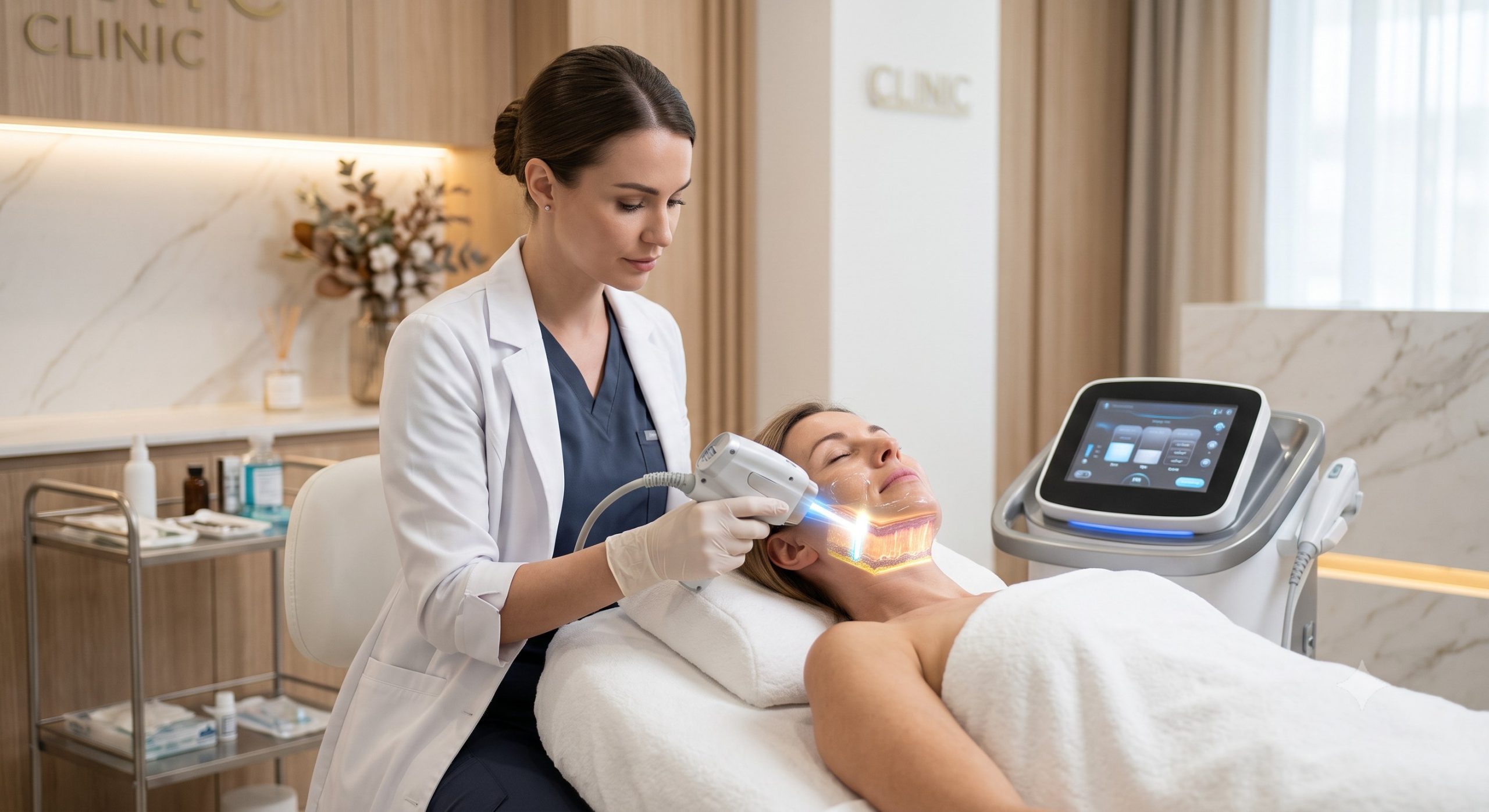
Both traditional and 7D HIFU devices operate on the principle of selective thermolysis, where focused ultrasound energy is deposited at specific tissue depths to achieve temperatures of 60-70°C. This induces coagulative necrosis, triggering the wound-healing cascade and subsequent collagen remodeling . The fundamental difference lies in the focal zone morphology and treatment depth range.
Traditional HIFU Physics
Conventional HIFU systems typically employ a single-frequency transducer (e.g., 4 MHz) or interchangeable cartridges with fixed focal depths, traditionally 1.5mm (superficial dermis), 3.0mm (deep dermis), and 4.5mm (SMAS layer) . These systems deliver a single, continuous line of energy per shot, creating a cigar-shaped thermal lesion approximately 2mm in width and 13mm in length along the ultrasound axis . While effective, the limited depth range restricts treatment to facial applications and requires longer treatment sessions—typically 45 minutes for a full-face procedure .
7D HIFU (MMFU) Physics
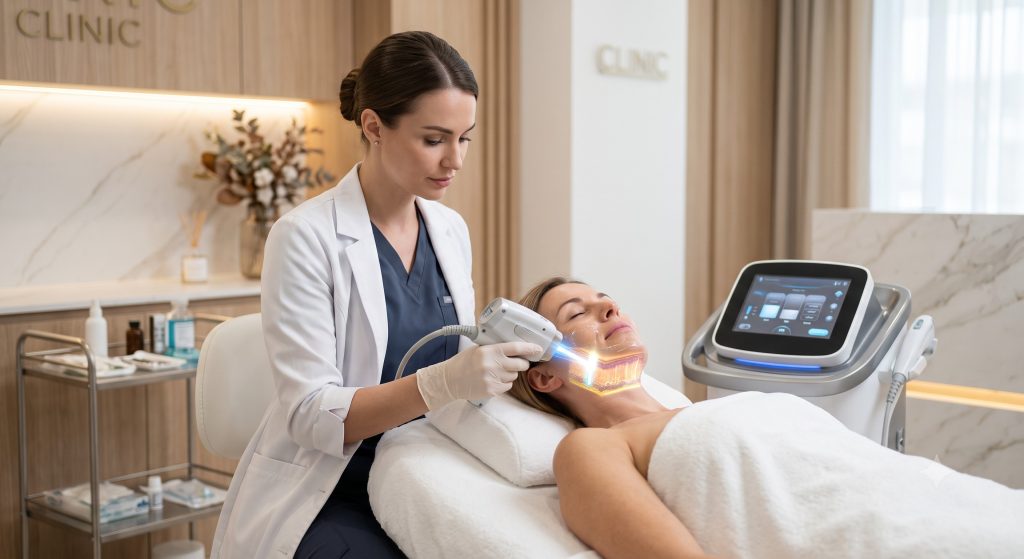
7D HIFU systems leverage MMFU technology, which combines Micro-Focused Ultrasound (MFU) for superficial skin texture improvement with Macro-Focused Ultrasound (MFU) for deep structural lifting and adipose reduction . The 7D architecture supports up to seven distinct treatment cartridges with focal depths ranging from 1.5mm to 13.0mm, including specialized 2.0mm cartridges for delicate periorbital and perioral regions . Critically, advanced 7D systems incorporate electronic steering of spherically curved transducers and adaptive energy modulation algorithms, enhancing targeting accuracy and treatment speed .
A key safety consideration highlighted in recent literature involves the 8.0mm and 13.0mm macro-focused transducers. While these deeper penetration depths enable body contouring, they necessitate rigorous operator training to avoid unintended damage to structures such as the carotid artery, particularly in areas with thin subcutaneous tissue . The thermal coagulation zone morphology differs significantly: macro-focused ultrasound creates larger, more expansive thermal volumes suitable for subcutaneous fat reduction, whereas micro-focused ultrasound generates smaller, precise focal points for dermal remodeling .
| Parameter | Traditional HIFU | Advanced 7D HIFU (MMFU) |
|---|---|---|
| Focal Depths | 1.5mm, 3.0mm, 4.5mm | 1.5mm, 2.0mm (Eye), 3.0mm, 4.5mm, 6.0mm, 9.0mm, 13.0mm |
| Technology | Single-focus Ultrasound | MMFU (Micro & Macro Focused) |
| Frequency Range | Typically 4 MHz | 2 MHz – 7.5 MHz |
| Full-Face Treatment Time | ~45 minutes | ~20–25 minutes |
| Cooling System | Passive / Gel | Active Sapphire Contact (TEC) |
| Cartridge Shot Lifespan | ~5,000 – 10,000 shots | ~15,000 shots |
| Regulatory Compliance | FDA, CE | FDA, CE (MDD & MDR certified) |
Technical Specifications & Hardware Architecture
The clinical performance of any HIFU system is defined by its hardware components, transducer quality, and precision engineering. Compliance with Medical CE, FDA clearance, and ISO 13485 standards is non-negotiable for patient safety and clinic liability protection. The following comparative analysis details the key hardware differentiators between standard HIFU and advanced 7D platforms:
Transducer Arrays & Focal Control
Traditional HIFU devices often utilize flat transducers with interchangeable acoustic lenses to achieve fixed focusing . In contrast, premium 7D HIFU systems integrate high-quality spherically curved transducers and even phased-array technology, which allows electronic steering of the focal point without physical movement of the probe . This innovation improves lateral resolution and targeting precision, enabling consistent energy delivery even in complex anatomical regions. The integration of machine learning algorithms for real-time adjustments based on tissue density represents the latest evolution in 7D HIFU systems, reportedly reducing variability and enhancing clinical outcomes .
Cooling Systems & Epidermal Protection
Epidermal cooling is paramount in high-energy aesthetic devices. Traditional HIFU devices frequently employ gel-based coupling or basic passive cooling. Advanced 7D HIFU platforms feature integrated Sapphire contact cooling mechanisms (TEC-based active cooling), significantly improving patient comfort, reducing the risk of thermal burns, and enabling higher fluence settings for enhanced efficacy . The cooling system is a critical determinant of treatment safety, particularly when using 6.0mm, 9.0mm, and 13.0mm macro-focused cartridges for body applications .
Comparative Parameter Matrix
| Parameter | Traditional HIFU | Advanced 7D HIFU (MMFU) |
|---|---|---|
| Focal Depths | 1.5mm, 3.0mm, 4.5mm (typically 3 cartridges) | 1.5mm, 2.0mm (Eye), 3.0mm, 4.5mm, 6.0mm, 9.0mm, 13.0mm (7 cartridges) |
| Technology Type | Single-focus Ultrasound | MMFU (Micro & Macro Focused Ultrasound) |
| Frequency Range | Typically 4 MHz (fixed) | 2 MHz – 7.5 MHz (multi-frequency support) |
| Treatment Areas | Primarily face & neck | Face, eye area, neck, body (arms, abdomen, thighs) |
| Full-Face Treatment Time | ~45 minutes | ~20–25 minutes |
| Cooling System | Passive / Gel coupling | Active Sapphire contact cooling (TEC) |
| Cartridge Shot Lifespan | ~5,000 – 10,000 shots | ~15,000 shots per cartridge |
| Regulatory Compliance | FDA, CE | FDA, CE (MDD & MDR certified) |
Treatment Efficacy & Clinical Outcomes
A randomized, single-blinded clinical trial evaluating the efficacy of an advanced HIFU device (More Young) against the standard 7D HIFU system provides critical insights into performance benchmarks. While both systems demonstrated significant post-treatment improvements in facial wrinkles and skin laxity, the modified system with enhanced focal depth precision and adaptive energy algorithms showed superior outcomes in wrinkle reduction, skin tightening, and texture enhancement, with higher patient satisfaction and fewer adverse effects . This suggests that incremental improvements in focal control and energy delivery directly translate to superior clinical results.
7D HIFU’s expanded depth range allows clinics to treat a wider patient demographic, addressing everything from superficial skin texture (1.5mm) to deep tissue laxity and localized adipose deposits (13.0mm) . The incorporation of a dedicated 2.0mm cartridge is particularly significant, enabling safe and effective treatment of the periorbital and perioral regions—areas often contraindicated in traditional HIFU due to the risk of thermal injury to delicate structures .
Fitzpatrick Skin Types & Safety Considerations
Traditional HIFU has a well-established safety profile across Fitzpatrick Skin Types I-VI . However, the introduction of deeper-penetrating macro-focused transducers in 7D HIFU necessitates a more nuanced approach. The risk of paradoxical adipose hyperplasia or unintended deep tissue damage increases with energy penetration beyond 4.5mm, particularly in areas where the SMAS layer is thinner . Therefore, clinicians must exercise extreme caution when using 8.0mm, 9.0mm, or 13.0mm cartridges, especially in patients with low body mass index (BMI) or in cervical regions . Rigorous operator training and real-time visualization systems are essential for mitigating these risks.
Clinical Conclusion & Investment Recommendations
7D HIFU technology represents a significant advancement over traditional HIFU, offering superior treatment speed, expanded clinical indications (face + body), and enhanced patient comfort through advanced cooling and precision focusing. The ability to treat a wider range of skin concerns—from fine lines to fat reduction—on a single platform maximizes clinic profitability and patient retention.
However, the selection of a 7D HIFU system must be driven by more than the number of cartridges. Clinics must prioritize device quality, hardware durability (imported laser bars, high-grade transducers), and robust regulatory compliance (Medical CE, ISO 13485). The clinical data shows that while both systems are effective, enhancements in focal control and energy modulation provide a measurable clinical edge . For high-throughput clinics, the time savings (20-25 minutes per full-face session) translate directly into increased patient volume and revenue.
In conclusion, upgrading to an advanced 7D HIFU system with MMFU technology is a strategic investment for aesthetic clinics aiming to expand their service portfolio and achieve superior, data-backed outcomes. When evaluating options, prioritize systems with verified certification, transparent consumable costs, and proven clinical efficacy through peer-reviewed literature.