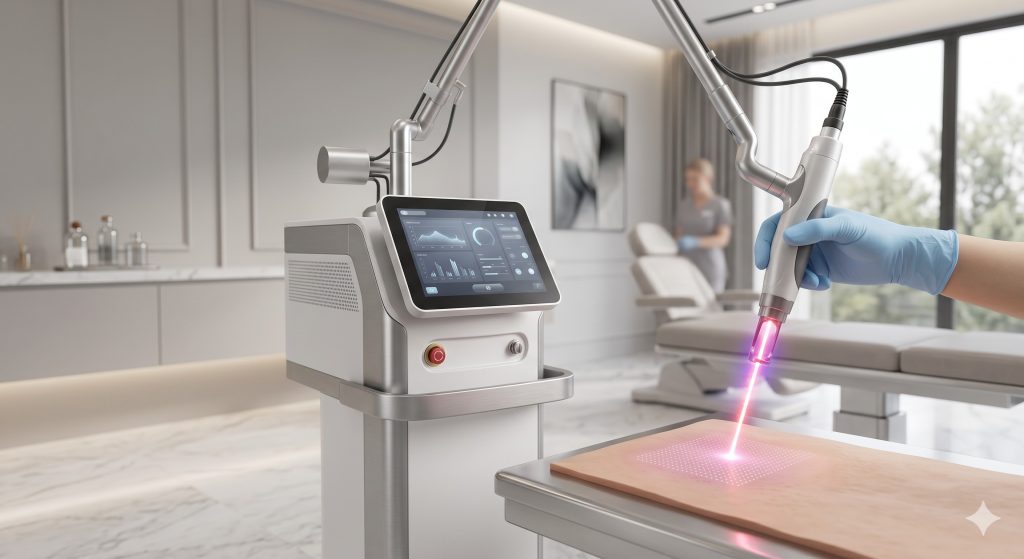
Beyond the Surface: Why Fractional thulium laser Demands a New Clinical Protocol
For decades, ablative and non-ablative resurfacing presented a binary choice for clinic owners: dramatic results with prolonged downtime, or modest improvements with minimal risk. Fractional thulium laser (1927 nm) technology disrupts this paradigm. Operating within the water absorption peak, this wavelength offers a true intermediate solution, targeting epidermal and superficial dermal pathologies with a precision that legacy systems like IPL (Intense Pulsed Light) or even early Er:YAG (2940 nm) devices cannot match. This deep-dive guide analyzes the physics, parameters, and business integration of Fractional thulium laser for the discerning medical aesthetics provider.
Physical Mechanism & Selective Photothermolysis at 1927 nm
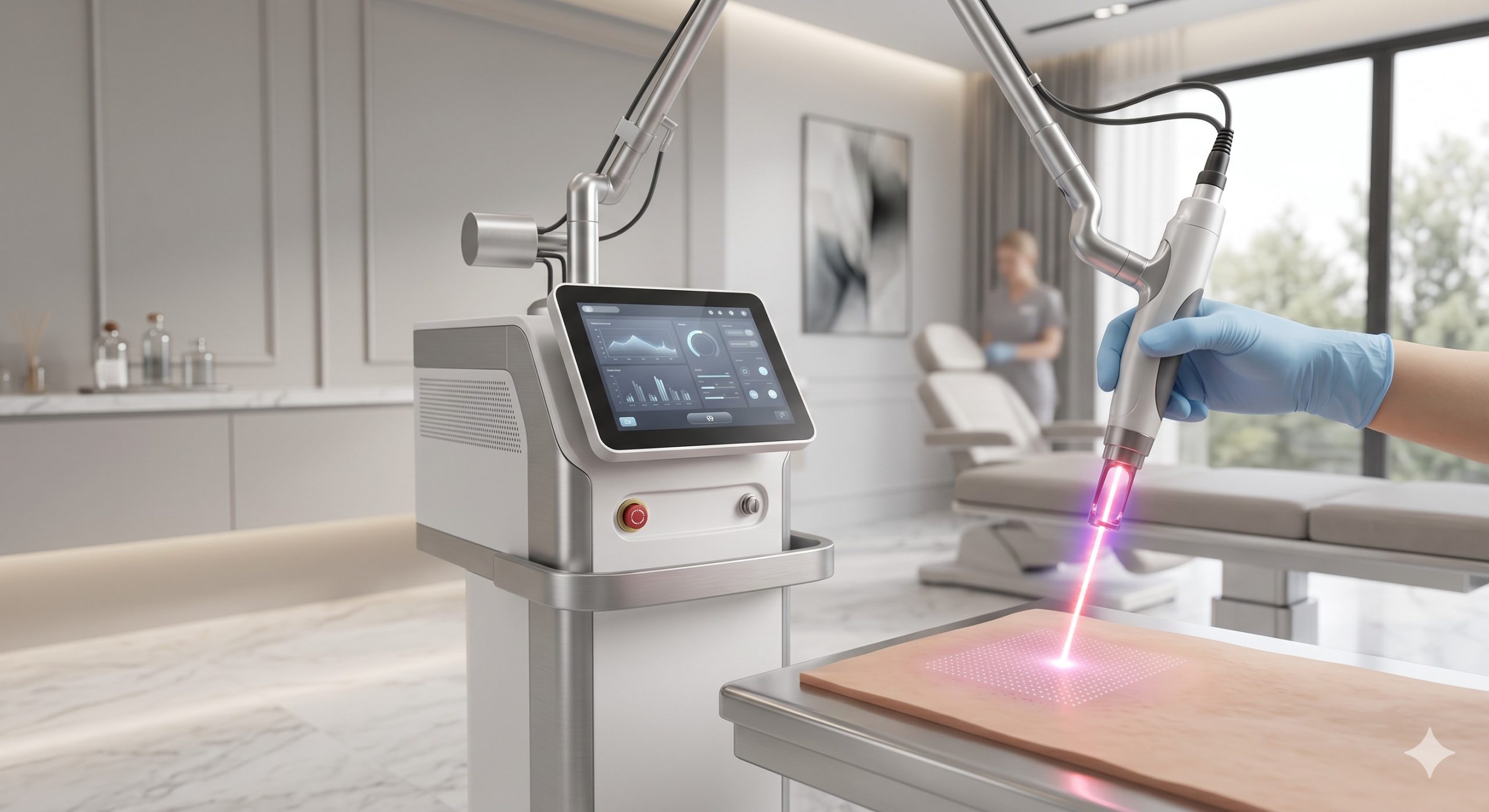
The clinical superiority of the Fractional thulium laser is rooted in its specific absorption coefficient in water. At 1927 nm, water absorption is significantly higher than at 1550 nm (traditional non-ablative erbium glass) but lower than at 2940 nm (ablative erbium). This creates microthermal zones (MTZs) of epidermal and papillary dermal coagulation without full-field ablation.
Core Output Metrics & Tissue Interaction
To achieve predictable melasma clearance or textural improvement, clinics must master three adjustable parameters:
- Energy Density (Fluence): Typically ranging from 5 to 50 mJ/MTZ. Lower fluences (5-15 mJ) target epidermal pigment (lentigos, seborrheic keratosis), while higher fluences (30-50 mJ) create deeper dermal heating for rhytides and scar remodeling.
- Treatment Coverage (Density): Expressed as a percentage (10-50%). Lower density (10-15%) is ideal for darker Fitzpatrick skin types (IV-VI) to minimize post-inflammatory hyperpigmentation (PIH). Higher density (40-50%) is suited for photodamaged skin on the face.
- Pulse Width & Spot Size: The Fractional thulium laser operates with pulse durations in the microsecond range (typically 200-500 µs). Spot size is fixed by the handpiece optics (e.g., 150 µm MTZ diameter), but coverage is dictated by scanning patterns.
This precision allows clinicians to bypass the CO2 laser’s (10600 nm) prolonged recovery while achieving superior pigment clearance compared to Q-Switched Nd:YAG (1064 nm) for dyschromia.
Epidermal Protection & Integrated Cooling Systems
Unlike legacy systems requiring separate cooling gels or cryogen spray, modern Fractional thulium laser platforms integrate advanced contact cooling. Sapphire or TEC (Thermoelectric Cooling) windows maintain epidermal temperatures between 0°C to 5°C during energy delivery. This is critical for patient comfort and safety, particularly when treating periorbital or perioral regions where skin is thin. The cooling mechanism preserves the stratum corneum while allowing controlled thermal injury to the targeted chromophores (melanin and water).
Technical Specifications & Compliance Standards
When evaluating a Fractional thulium laser system for clinic integration, verify adherence to Medical CE (Class IIb or III), FDA 510(k) clearance, and ISO 13485:2016 manufacturing certification. Below is the reference specification matrix for an industry-standard device.
| Key Parameter | Technical Specification |
|---|---|
| Wavelength / Laser Type | 1927 nm Solid State Thulium Fiber Laser (Non-Ablative Fractional) |
| Cooling System | Integrated Sapphire Contact Cooling (0°C to +4°C) with TEC Module |
| Energy Density (Fluence) | 5 mJ to 50 mJ per Microthermal Zone (MTZ) |
| Spot Size / MTZ Diameter | 100-200 µm (Variable by Handpiece Optics) |
| Coverage Density | 5% to 50% Surface Area Coverage per Pass |
| Max Treatment Depth | 300-400 µm (Epidermis to Superficial Dermis) |
| Regulatory Compliance | Medical CE (Class IIb), FDA 510(k) KXXXXXX, ISO 13485 |
| Handpiece Lifespan | >2 Million Shots (Laser Bar Durability) |
| Pulse Width | 200-500 µs (Microsecond Domain) |
Optimizing Parameters for Fitzpatrick Skin Types I-VI
The versatility of the Fractional thulium laser allows safe treatment across a broad demographic, provided protocols are adjusted.
Protocol Mapping for Clinical Safety
- Fitzpatrick I-III (Fair to Olive): Aggressive parameters are well-tolerated. Use fluence 30-50 mJ, coverage 30-50%, up to 3-4 passes. Indications: Actinic keratosis, deep rhytides, acne scars.
- Fitzpatrick IV-V (Brown to Dark Brown): Moderate parameters with extended cooling pre-pulse. Use fluence 15-25 mJ, coverage 15-25%, single pass with low overlap. Pre-treat with hydroquinone 4% for 4 weeks to mitigate PIH risk.
- Fitzpatrick VI (Dark Brown/Black): Lowest parameters. Use fluence 5-10 mJ, coverage 5-10%. Strictly avoid high-density stacking. Indications: Refractory melasma, post-inflammatory hyperpigmentation.
Post-treatment, mandate broad-spectrum SPF 50+ (zinc oxide/titanium dioxide) and non-occlusive emollients. Downtime averages 2-4 days of erythema and mild bronzing versus 14-21 days for Fractional CO2.
Clinic ROI & Integration Strategy for Fractional thulium laser
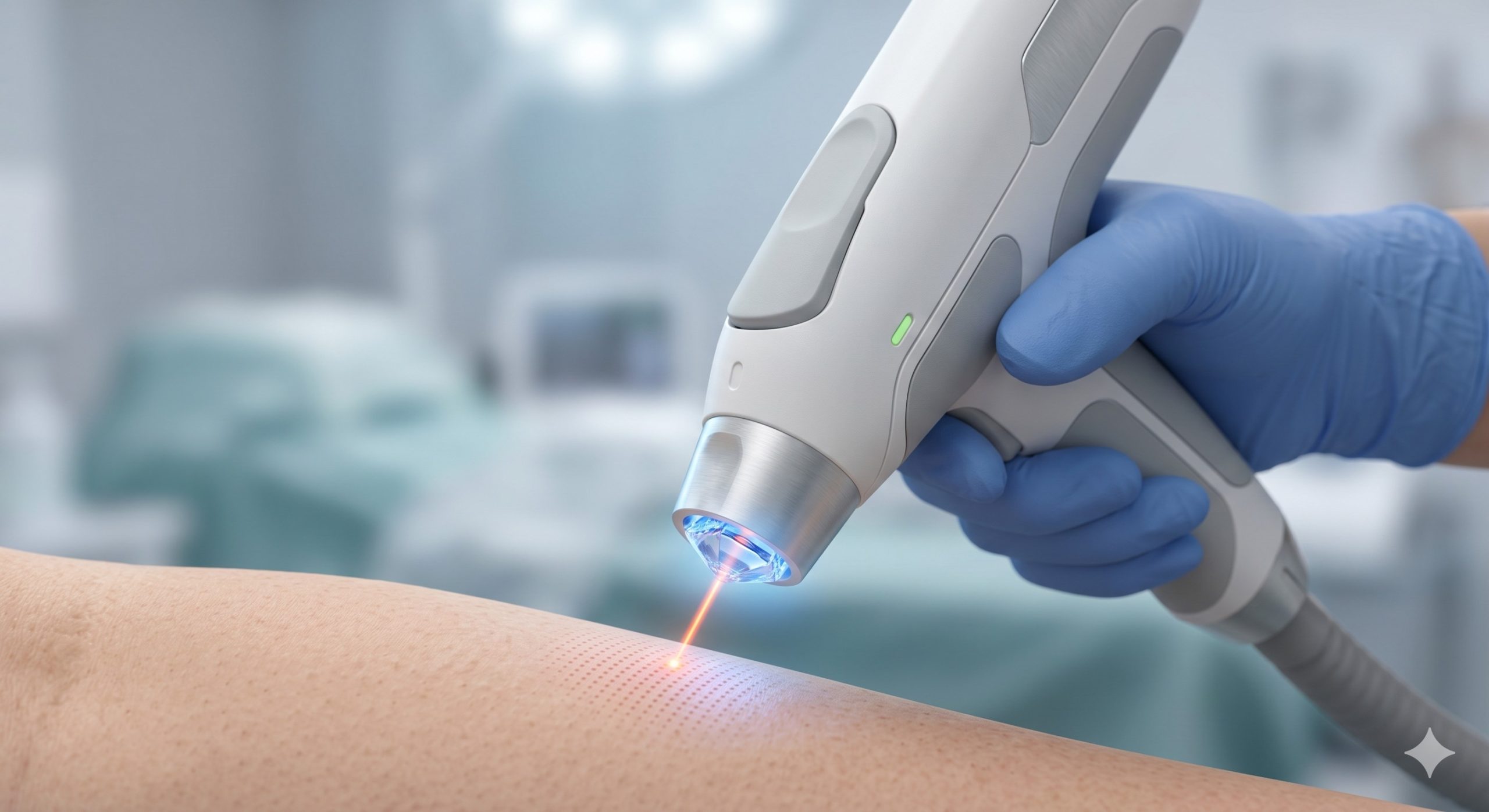
From a business consultant’s perspective, the Fractional thulium laser offers an optimal return on investment (ROI) as a high-volume, low-consumable treatment. Pricing models typically achieve $400-$800 USD per session for full-face resurfacing, with package sales (3-5 sessions) generating $1,500-$3,500 per patient. With handpiece lifetimes exceeding 2 million pulses (equivalent to 500+ full-face treatments) and no disposable tips (unlike microneedling RF), the cost per patient for consumables is near zero. The device also serves as a gateway to higher-ticket procedures like surgical lifts or injectables. For clinics targeting medical tourism or premium corporate wellness, marketing the ‘lunchtime resurfacing’ aspect with minimal social downtime drives high patient acquisition. Ensure your team completes manufacturer-certified training on parameter stacking and endpoint recognition to avoid complications and leverage the device’s full clinical clearance rates, which exceed 70% for mixed melasma in peer-reviewed studies.