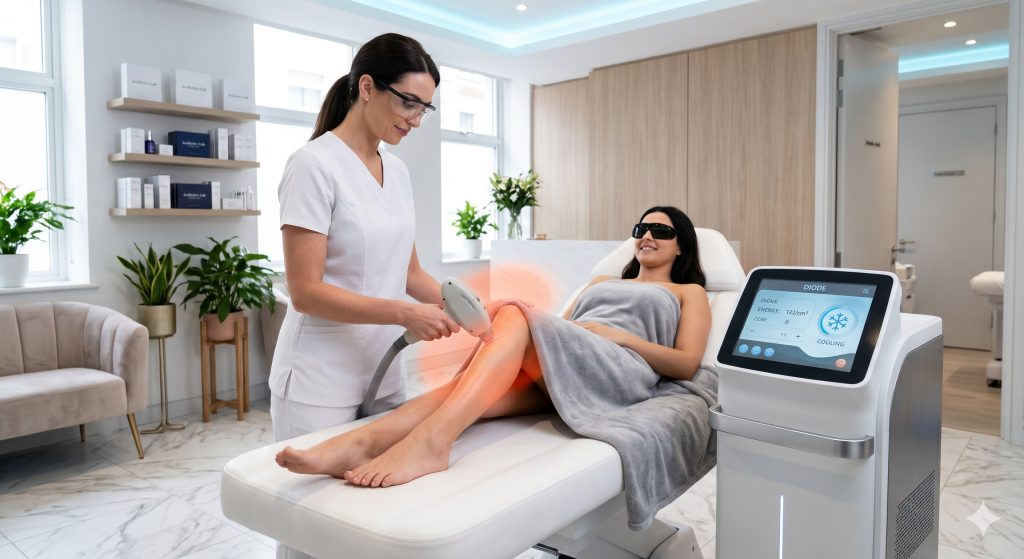
Introduction: The Clinical Standard for Permanent Hair Reduction
For medical aesthetic clinics seeking a reliable, high-ROI core service, diode laser hair removal remains the gold standard technology. Unlike outdated systems (IPL) or alternative wavelengths with limitations, modern diode lasers operating at 808nm offer an optimal balance between melanin absorption and deep follicular penetration. This guide provides an evidence-based technical analysis of clinical efficacy, hardware specifications, safety protocols, and financial modeling for clinic owners and dermatologists.
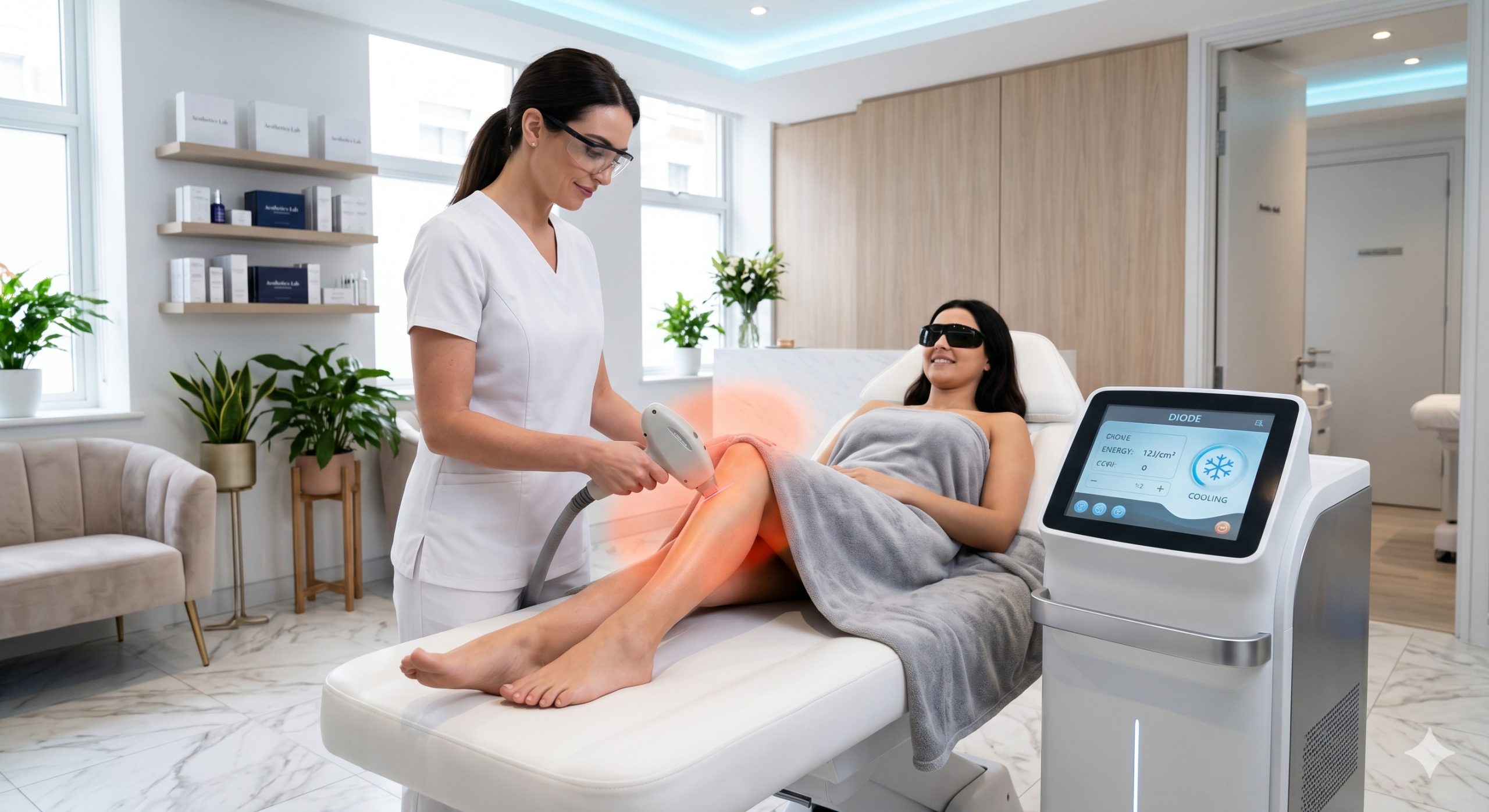
Selective Photothermolysis: The Physics of Permanent Results
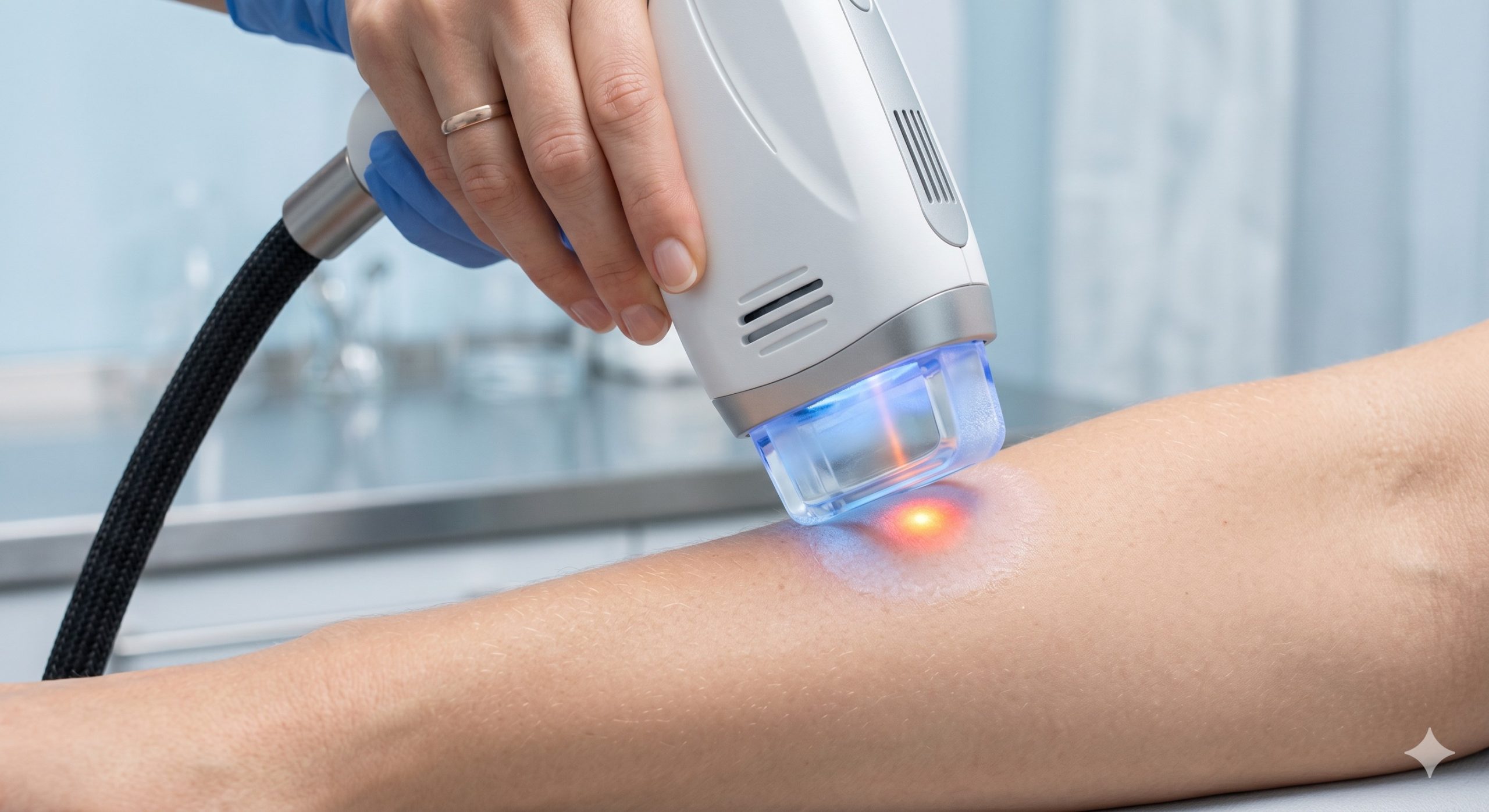
The principle of selective photothermolysis governs all effective laser hair removal. A diode laser emits a coherent, monochromatic beam absorbed preferentially by melanin within the hair shaft and bulb. When the fluence (energy density), pulse width, and wavelength are optimized, thermal energy confines to the follicle, achieving temperatures of 70°C–80°C. This coagulates the germinal matrix and bulge region (containing stem cells) without damaging the surrounding dermis. For clinics, understanding these metrics directly translates to predictable clearance rates of 70-90% after 3-6 sessions.
Critical Technical Metrics for Clinical Success
When evaluating a diode laser system, demand verifiable specifications:
- Wavelength: 808nm (diode) is the clinical benchmark. Multi-wavelength platforms adding 755nm (Alexandrite, high melanin absorption) and 1064nm (Nd:YAG, deep penetration for darker skin) offer versatility but require precise parameter control.
- Fluence (Energy Density): Ranges from 10-120 J/cm². Dark, coarse hair needs lower fluence (10-30 J/cm²) to avoid epidermal injury; lighter, finer hair or deep follicles require higher fluence (40-80 J/cm²).
- Pulse Width: Typically 5-400 ms. Shorter pulses (5-30 ms) target thin, dark hair. Longer pulses (100-400 ms) are safer for Fitzpatrick Skin Types IV-VI or larger-diameter terminal hairs.
- Spot Size: Larger spots (12-24 mm²) increase treatment speed and depth due to scattering effects. Small spots (under 8mm²) risk thermal injury and are inefficient for large body areas.
- Repetition Rate: Modern diodes achieve 1-10 Hz. Higher rates (5-10 Hz) enable fast full-leg treatments (15-20 minutes), improving patient throughput and clinic profitability.
| Parameter Category | Clinical Specification |
|---|---|
| Primary Wavelength | 808nm Diode (Standard) / 755nm + 808nm + 1064nm (Triple Wave) |
| Fluence Range | 10 – 120 J/cm² |
| Pulse Width | 5 – 400 ms (adjustable) |
| Spot Size | 8mm – 24mm (interchangeable tips) |
| Cooling System | Sapphire Contact Cooling (0°C to 5°C) + TEC |
| Repetition Rate | 1 – 10 Hz |
| Handpiece Shot Lifespan | 1 – 2 million shots (ISO 13485 bars) |
| Certifications | Medical CE (IIb), FDA 510(k), ISO 13485, IEC 60825-1 |
Epidermal Protection: Sapphire Contact Cooling & TEC Systems
Patient comfort and safety are non-negotiable. High-quality diode lasers integrate active cooling mechanisms:
- Sapphire Contact Cooling: A transparent sapphire window pre-cools the epidermis to 0°C to 5°C before the laser pulse and remains in contact during delivery. This minimizes pain (reducing need for topical anesthetics) and allows higher fluences for stubborn hair.
- Thermoelectric (TEC) Cooling: Built into the handpiece, TEC modules actively extract heat from the sapphire tip, maintaining consistent low temperatures over long treatment sessions (critical for high-volume clinics).
- Imported Laser Bars (e.g., Jenoptik, Coherent): The diode laser bar quality determines energy stability and handpiece lifespan. Reputable manufacturers provide ISO 13485-certified bars with >1-2 million shot lifespan before 20% power degradation.
Treating Fitzpatrick Skin Types I-VI: A Protocol Matrix
The primary clinical risk is epidermal thermal injury (burns, PIH) in melanin-rich skin. A systematic approach is mandatory:
- Fitzpatrick I-III (Fair to Olive): 808nm diode, fluence 30-50 J/cm², pulse width 10-50 ms, spot size 12mm. Expect rapid hair reduction. Test spot 48h prior.
- Fitzpatrick IV-V (Olive to Brown): Prefer multi-wavelength (808nm + 1064nm) or lower fluence 808nm (15-35 J/cm²) with longer pulse width (50-150 ms). Active sapphire cooling is essential.
- Fitzpatrick VI (Dark Brown to Black): Use 1064nm Nd:YAG mode if available (fluence 20-40 J/cm², pulse width 40-300 ms) or very conservative 808nm parameters. Avoid 755nm. Always perform a test spot and consider spot size reduction to 8-10mm for better epidermal safety.
Regulatory Compliance & Clinic Investment Protection
Before purchasing, verify the following certifications to protect your clinic from liability and ensure reimbursement from medical insurances for indicated cases (e.g., hidradenitis suppurativa, pseudofolliculitis barbae):
- Medical CE (Class IIb or higher) – mandatory for European clinics.
- FDA 510(k) clearance – for the US market, specifically for “permanent hair reduction.”
- ISO 13485:2016 (Medical devices – Quality management systems).
- IEC 60825-1 (Laser safety classification – typically Class 4).
Clinic ROI Analysis: CapEx, OpEx, and Throughput
A diode laser hair removal system is a high-ticket investment (typically $15,000 – $60,000). Justify the capital expense with data:
- Average Revenue per Session: $150 (upper lip) to $600 (full legs). National averages in the US: $300-450 per large area.
- Consumables Cost: Minimal. The primary consumable is the diode laser bar (after 1-2 million shots, expect 15-25% output loss). Replacement handpieces cost $800-$2,500. There are no gels or tips per patient (unlike IPL).
- Treatment Throughput: With a repetition rate of 10 Hz and spot size of 22mm, a clinician can treat a full back in 25 minutes. Assuming 4 large-area patients per day at $350 average, weekly revenue = $7,000. ROI break-even is typically 3-6 months at 60% clinic utilization.
- Lifetime Cost of Ownership (TCO): Factor in yearly calibration ($300-$800), water cooling circuit maintenance (if closed-loop, minimal), and potential handpiece repair. Brands with local technical support reduce downtime.
Conclusion: Selecting Your Diode Laser Partner
For clinic principals, the decision should balance clinical efficacy (808nm or triple wavelength, sapphire cooling, validated fluence/pulse width ranges), regulatory pedigree (FDA, CE, ISO 13485), and post-sale support. Avoid white-label devices without published technical specifications or local service infrastructure. A superior diode laser hair removal system is not an expense but a profit center that builds patient loyalty through safe, rapid, and permanent outcomes. For dermatologists, mastering parameter customization per Fitzpatrick type and body area will differentiate your practice in an increasingly competitive aesthetic market.