The Hidden Drain on Clinic Profitability: Why Consumable Inventory Management Matters More Than You Think
For the modern medical aesthetics clinic, the allure of a high-ticket laser device often overshadows the silent, recurring financial drain of its consumables. While the initial capital expenditure (CapEx) for a premium diode laser—featuring cutting-edge wavelengths like 808nm or the tri-wavelength synergy of 755nm, 808nm, and 1064nm—is significant, the operational expenditure (OpEx) tied to managing consumable inventory for lasers frequently determines the long-term viability and profitability of the practice. A 2024 industry analysis by the Medical Aesthetic Practice Association revealed that consumables and maintenance can account for up to 30% of a laser’s lifetime cost, a figure that can balloon to 45% if inventory is poorly managed. This is not merely a matter of ordering replacement parts; it is a strategic business function that impacts everything from treatment throughput to patient safety and regulatory compliance (FDA, Medical CE, ISO 13485). This comprehensive guide is engineered for the discerning clinic owner and medical director, providing a data-driven roadmap to mastering your laser’s consumable lifecycle, optimizing clinical performance, and securing a robust return on investment.
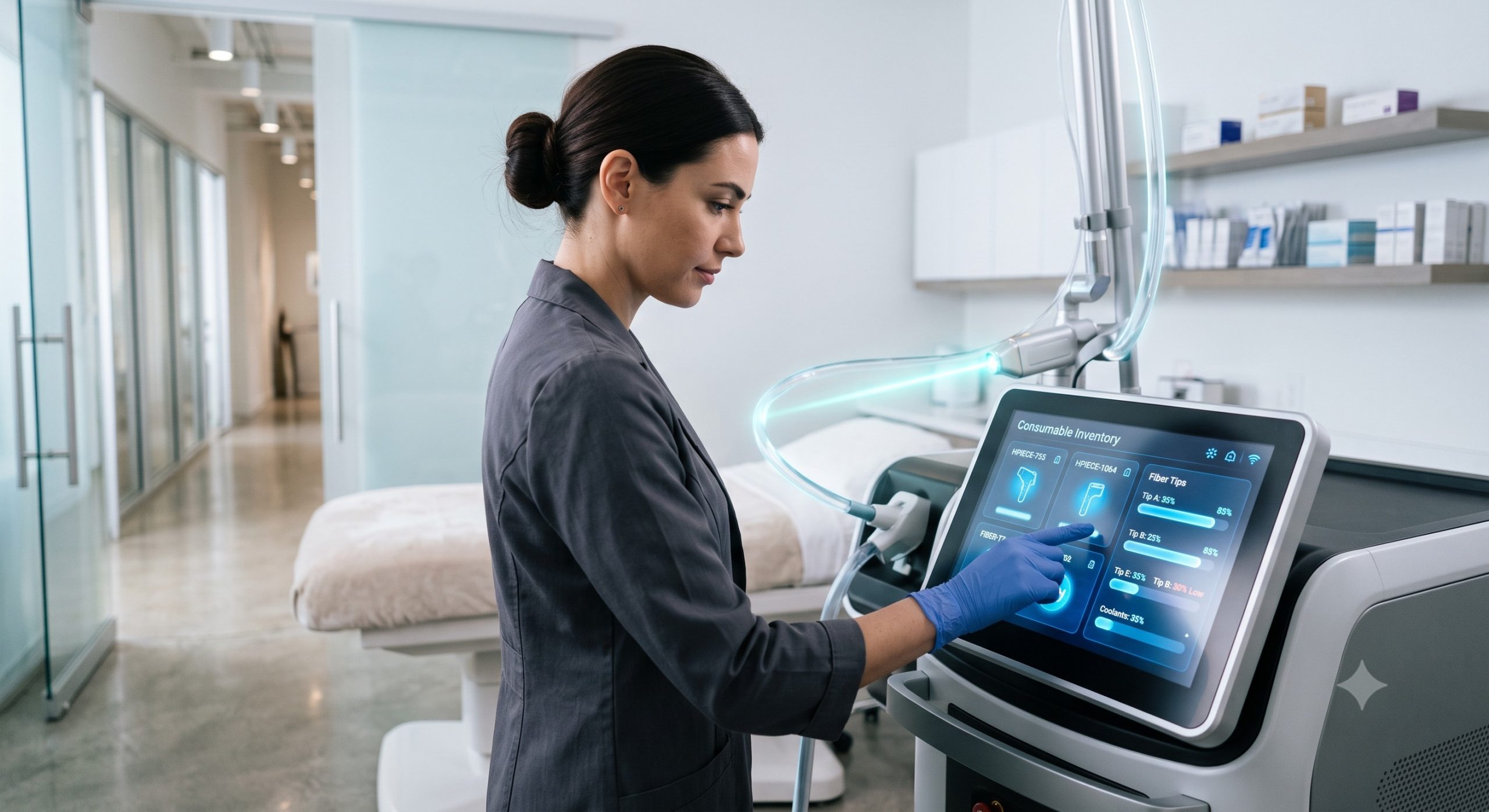
Decoding the Lifeline: Understanding Core Consumables in Aesthetic Lasers
To effectively manage consumable inventory for lasers, one must first understand the critical components that constitute this inventory. These are not just simple lightbulbs; they are precision-engineered subsystems that dictate the clinical efficacy and safety profile of your device. The primary consumables and wear-items fall into several key categories, each with distinct lifespans and cost implications.
1. The Laser Handpiece & Emitter Modules (The Clinical Engine)
The handpiece is the most vital and expensive consumable. At its heart lies the laser bar, an array of laser diodes that generate the specific wavelength (e.g., the deep-penetrating 1064nm for vascular lesions or the melanin-targeting 755nm for superficial hair). The quality of these bars, often denoted as ‘imported’ (from premium global suppliers like Jenoptik or DILAS), directly correlates with clinical stability and lifespan. Industry standards, guided by ISO 13485, stipulate a ‘shot count’—the number of pulses the handpiece can deliver before a drop in fluence (energy density, measured in J/cm²) becomes clinically significant. Premium handpieces are often rated for 1,000,000 to 3,000,000 shots. Managing consumable inventory for lasers requires meticulous tracking of this shot count, as replacing a handpiece prematurely erodes ROI, while using one beyond its prime compromises treatment outcomes for conditions like psoriasis or vascular lesions, leading to patient dissatisfaction and potential revenue loss.
2. Cooling System Components (The Thermal Safety Net)
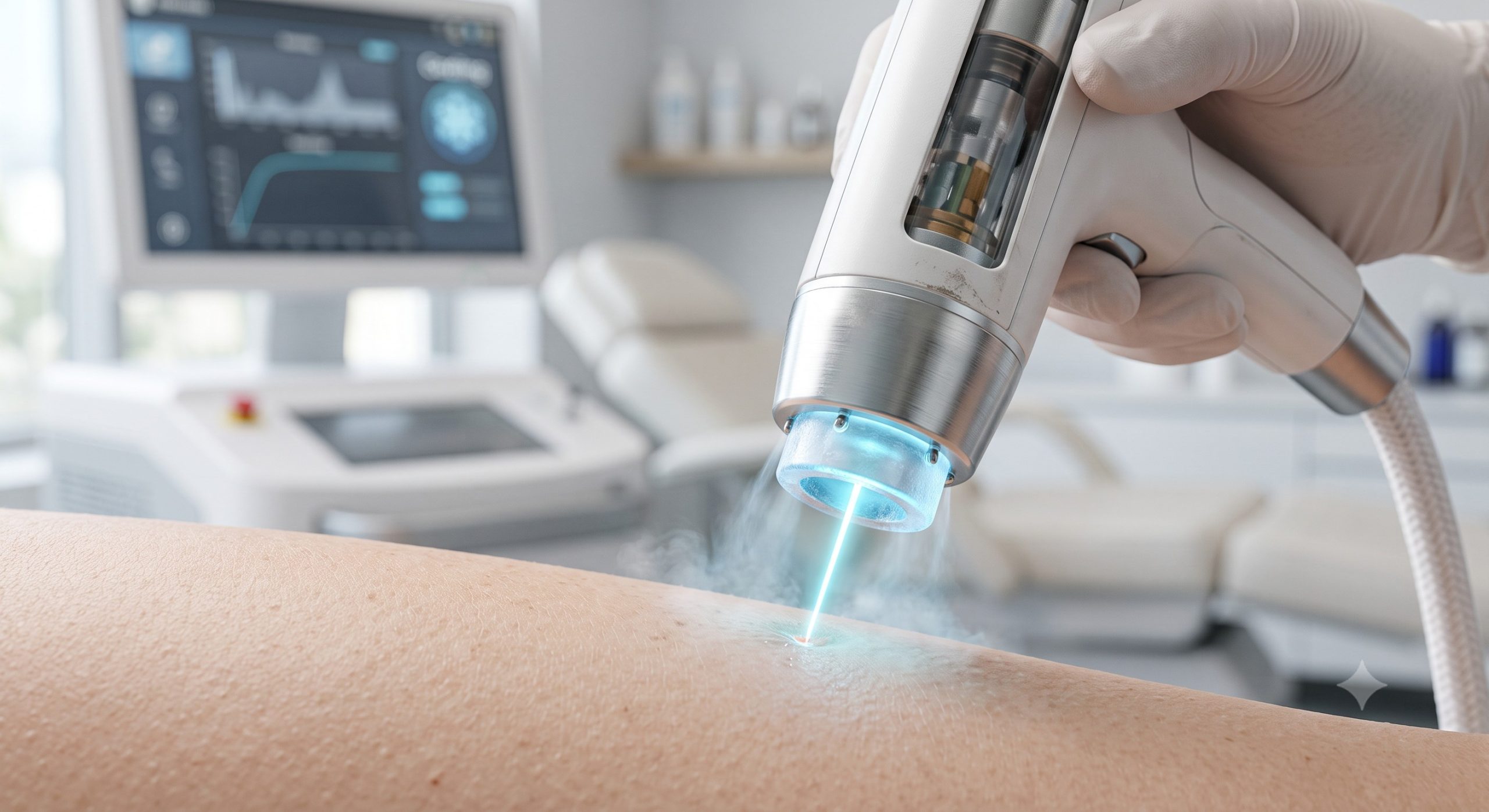
High-energy laser treatment generates significant heat, making epidermal protection paramount. This is primarily achieved through advanced cooling mechanisms, most notably the Sapphire contact cooling window at the tip of the handpiece. This sapphire crystal is not just a window; it’s a critical component that maintains the skin’s surface temperature at a safe 0-5°C, preventing thermal injury during high-fluence treatments. However, the entire cooling ecosystem—including the internal water chiller, TEC (Thermoelectric Cooler) modules, pumps, and coolant fluid—requires regular maintenance and periodic replacement. Neglecting the cooling circuit can lead to catastrophic handpiece failure, costing thousands in emergency replacements. Effective consumable management involves a scheduled protocol for water quality checks, coolant changes, and monitoring the performance of the recirculating pump, ensuring the device consistently meets its Cooling System specifications.
3. Interface & Accessory Consumables (The Hygiene and Optics Layer)
This often overlooked category includes items like laser safety goggles (which degrade over time, losing their optical density), cleaning swabs and isopropyl alcohol for optics, and single-use ultrasound gel or patient interface materials. While seemingly minor, in a high-throughput clinic, the recurring cost of these items contributes significantly to the OpEx and should be factored into the treatment pricing model. Furthermore, the cleanliness of the optics within the handpiece directly affects energy transmission, with dust or residue scattering the beam and reducing effective fluence, thereby impacting clinical results and wasting consumable shot count.
Strategic Frameworks for Optimizing Consumable Inventory
1. The Data-Driven Approach: Tracking and Analytics
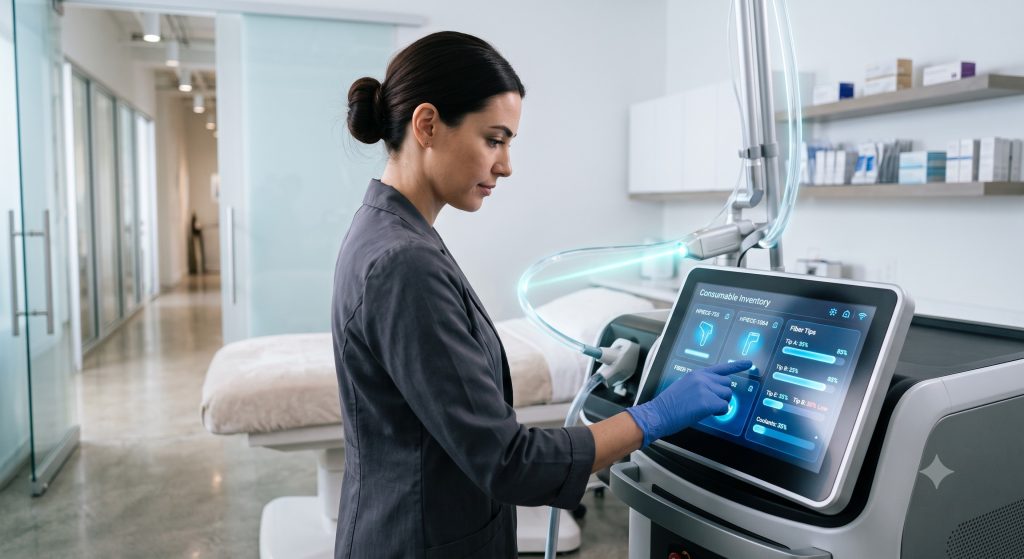
In the age of smart technology, manual logbooks are obsolete. Modern medical aesthetic devices, particularly those compliant with FDA and Medical CE standards, offer digital interfaces that track key performance metrics. Clinic management software can be integrated to automatically record the shot count of each handpiece, the operating hours of the cooling system, and even flag scheduled maintenance for laser bars. By analyzing this data, clinic operators can forecast consumable replacement with high precision, moving from a reactive ‘break-fix’ model to a proactive, budget-predictive strategy. For instance, tracking the correlation between Fluence (J/cm²) and Spot Size (mm²) over the life of a handpiece provides objective data on performance degradation, enabling an evidence-based decision on when to retire a laser bar.
2. Vendor Partnerships: The Bulk Purchase and Contract Strategy
Managing consumable inventory for lasers is a financial exercise as much as a logistical one. Clinics should leverage their purchasing power by entering into maintenance and consumables contracts with manufacturers or authorized distributors. These contracts often offer tiered pricing based on the number of handpieces or maintenance visits, effectively lowering the per-shot cost of consumables. Furthermore, strategic bulk purchasing of high-use items like cleaning supplies and goggles, while balancing storage costs, can yield significant annual savings. However, critical components like laser bars should not be overstocked, as they degrade over time even when not in use, and their technology may be superseded. A just-in-time (JIT) inventory model, backed by a strong vendor service-level agreement (SLA), is often the most efficient strategy for these expensive capital components.
3. Clinical Protocol Standardization: Extending Lifespan Through Smart Practice
The clinical operator is the most influential variable in consumable longevity. Standardizing clinical protocols to optimize parameter selection can dramatically reduce consumable wear and tear without compromising results. For example, using the appropriate Pulse Width (milliseconds) for a given Fitzpatrick Skin Type ensures maximal efficacy with minimal energy, reducing the strain on the diode array. Similarly, strictly adhering to cooling system maintenance routines (e.g., weekly filter cleaning, quarterly coolant flushes) as per ISO 13485 guidelines prevents premature failure of the pump and TEC modules. Training operators on these protocols and emphasizing the financial impact of their clinical decisions fosters a culture of efficiency, directly influencing the clinic’s bottom line.
| Key Parameter | Technical Specification | Clinical Impact |
|---|---|---|
| Wavelength / Laser Type | 755nm (Alexandrite), 808nm (Diode), 1064nm (Nd:YAG) (Often in Multi-Wavelength Platforms) | Enables selective targeting of melanin (hair/pigment) or hemoglobin (vascular), allowing treatment across Fitzpatrick Skin Types I-VI. |
| Handpiece Shot Count (Lifespan) | 1,000,000 to 3,000,000 pulses (Industry Premium Standard) | Directly correlates with long-term consumable cost and device ROI. Higher count lowers per-treatment OpEx. |
| Cooling System | Sapphire Contact Cooling (with Integrated TEC Modules) | Maintains epidermal temperature at 0-5°C, enabling use of higher Fluence (J/cm²) for better efficacy while ensuring patient comfort and safety, preventing burns. |
| Spot Size | Range from 10mm to 24mm (Adjustable) | Large spot sizes (e.g., 24mm) reduce treatment time for large areas, improving throughput. Smaller spot sizes (10mm) offer precision for small areas, influencing energy density (Fluence). |
| Fluence (Energy Density) | Up to 100 J/cm² (Device Dependent) | Higher fluence levels, when paired with effective cooling, increase the ability to treat challenging indications (e.g., deep vascular lesions) and coarser hair, improving clearance rates. |
| Pulse Width | Range from 0.1ms to 400ms (Adaptable) | Longer pulse widths are optimal for deeper, less pigmented hair (Fitzpatrick V-VI), while shorter pulses are effective on fine, superficial hair (Fitzpatrick I-III), enabling safe and effective treatment. |
Calculating the True Lifetime Cost of Ownership (TCO)
To truly master the economics of your aesthetic laser, the concept of Total Cost of Ownership (TCO) must be your guiding metric. TCO goes beyond the initial purchase price to encapsulate all costs associated with owning and operating the device over its expected useful life (typically 5-7 years). This is the definitive metric for managing consumable inventory for lasers.
The TCO Formula
TCO = Initial Capital Cost + (Annual Consumable Cost x Lifecycle) + (Annual Service & Maintenance Cost x Lifecycle) + (Training & Installation Cost)
Let’s break down the components using industry-standard data points:
- Initial Capital Cost: The sticker price of the laser device.
- Annual Consumable Cost: This includes the amortized cost of a new handpiece (e.g., $3,000 to $5,000 for a high-end diode laser bar replacement) plus the yearly cost of cooling system maintenance (pump, coolant, filters) and other disposables. For a clinic averaging 10,000 shots per month, a premium handpiece with a 2,000,000 shot lifespan will need replacement every 16.7 years, effectively making its cost negligible on a per-shot basis. However, inferior laser bars with a 500,000 shot lifespan would require replacement every 4.2 years, dramatically increasing the annual OpEx.
- Annual Service & Maintenance Cost: Mandatory annual maintenance to retain manufacturer warranties and ensure compliance with Medical CE and FDA standards. This can range from $1,000 to $3,000 per year.
- Training & Installation Cost: One-time setup fees.
A smart TCO analysis pushes clinics to avoid ‘cheap’ devices with low CapEx but high consumable costs and frequent downtime, as these significantly increase the per-treatment cost. For instance, a device with a less efficient cooling system (requiring more frequent and costly TEC module replacements) will have a higher TCO, directly impacting the profitability of services like hair removal and pigment correction. Therefore, evaluating a device’s engineering, particularly its Selective Photothermolysis precision and cooling efficiency, is paramount. Always demand to see the manufacturer’s documented ‘shot life’ and failure rate data, which is often a part of their ISO 13485 Quality Management System.
Clinical and Financial Impact: Real-World Scenarios
Scenario A: The Mismanaged Practice
A busy med spa purchases a mid-tier 808nm diode laser. They don’t track shot count and perform minimal maintenance. After 18 months, the handpiece overheats and fails, costing $4,000 for an emergency replacement. Service records show the water chiller is clogged, requiring a $1,500 flush and pump replacement. Meanwhile, the clinic’s treatment revenue has dropped by 30% during the 2-week downtime. The unplanned $5,500 expense and lost revenue represent a catastrophic hit to the clinic’s annual profit margin, directly attributable to poor consumable inventory management.
Scenario B: The Optimized Clinic
A leading dermatology clinic invests in a premium tri-wavelength (755/808/1064nm) laser with a built-in ‘Intelligent Shot Counter’. The clinic uses a digital inventory system to forecast handpiece replacement at 1.8 million shots, aligning it with their annual budget cycle. They have a service contract with a guaranteed 48-hour response time for maintenance and a 15% discount on bulk handpiece purchases. Their per-shot consumable cost is consistently optimized, downtime is virtually zero, and they are able to confidently market their device’s reliability and precision, reinforcing their reputation for clinical excellence. This strategy allows them to maintain a 15% higher profit margin on treatments compared to their competitors.
Integrating with Multi-Modality Workflows
In a modern clinic, a laser is seldom a standalone device. It is often part of a Combination Therapy workflow, paired with devices like radiofrequency (RF) or ultrasound. In such environments, managing consumable inventory for lasers becomes even more critical. Cross-utilization of handpieces between treatment rooms, if not standardized, can accelerate wear and confuse shot count tracking. Similarly, a shared Cooling System central unit feeding multiple handpieces demands even more rigorous maintenance scheduling. Clinics that successfully integrate their consumable management across all devices, often via a centralized inventory management software, gain a significant operational advantage. This holistic view allows for better forecasting, bulk discounts on shared consumables (like cooling fluids and cleaning supplies), and a more streamlined maintenance schedule, ultimately enhancing the overall efficiency of the service offering.
Conclusion: The Strategic Imperative of Proactive Inventory Management
For the elite medical aesthetics professional, managing consumable inventory for lasers is not a peripheral administrative task; it is a strategic imperative that directly influences clinical efficacy, patient safety, and financial performance. A hands-off approach is a direct path to revenue leakage, operational disruption, and potential compliance issues with Medical CE and FDA standards. By adopting a data-driven mindset, building strategic vendor partnerships, and standardizing clinical protocols, clinics can transform their consumable inventory from a source of anxiety into a lever for growth. The principles of precise tracking, proactive maintenance, and rigorous TCO analysis are the hallmarks of a well-managed, profitable, and reputable practice. In an industry where technology is the product, the true differentiator is the intelligence with which it is managed.